Honest dosage analysis
How is ExiTide dosed?
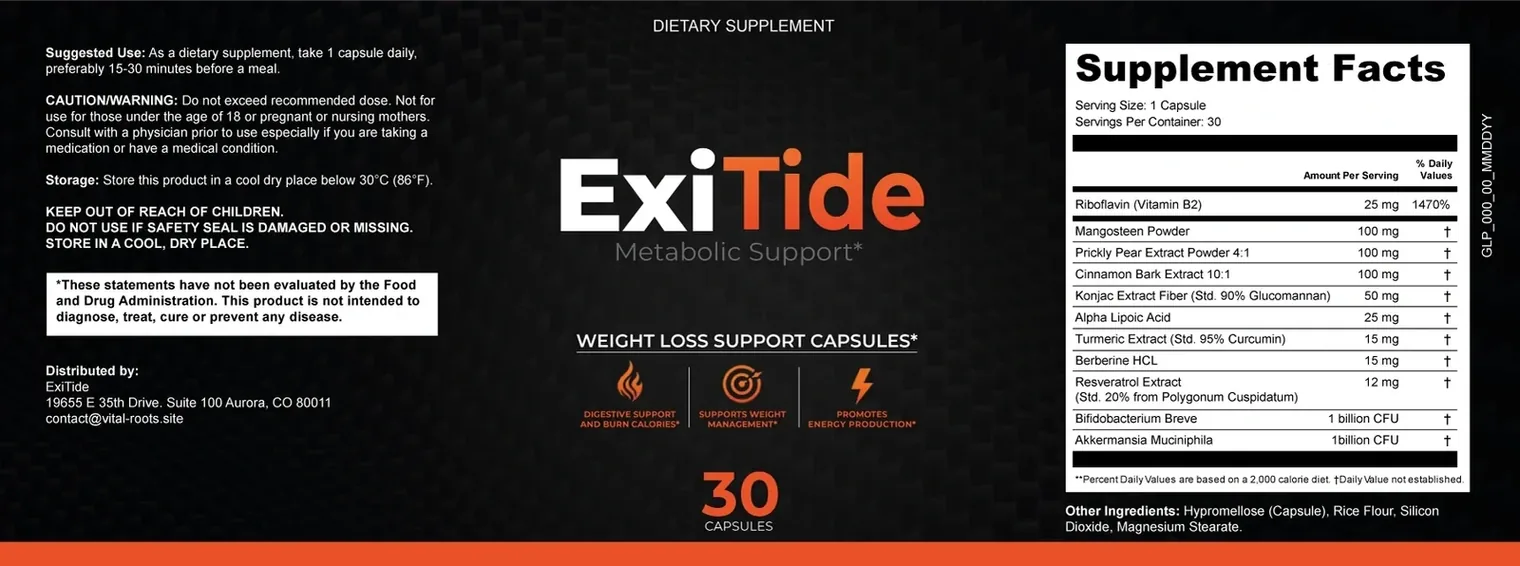
ExiTide is dosed at one capsule a day, so each printed amount on the panel is the amount in a day. Nine of the eleven amounts sit below the amounts the cited studies used.
Every printed amount beside the amount the research used.
Because all eleven amounts are printed, each can be set beside the amount a study used. Nine sit below it — two do not, and those two come first.
Every ExiTide amount set beside the amount the research used
| Ingredient, as the panel prints it | One capsule gives | What the research used | The comparison |
|---|
| Konjac extract fibre (90% glucomannan) 50 mg | 45 mg of glucomannan | 1.24 to 3.99 g a day in the trials ODS summarises (NIH ODS) | about one twenty-eighth of the smallest trial dose, and about one eighty-ninth of the largest |
| Berberine HCl 15 mg | 15 mg of berberine | more than 1 g a day for more than eight weeks, where NCCIH says the weight effects were seen (NCCIH) | about one sixty-seventh of that threshold |
| Resveratrol extract (20%) 12 mg | 2.4 mg of resveratrol | 150 mg a day for 30 days (Timmers 2011) | about one sixty-third of the trial dose |
| Turmeric extract (95% curcumin) 15 mg | about 14 mg of curcumin | 80 mg a day at the very lowest, in a nano-curcumin, and 1,000 mg a day most commonly (Akbari 2019) | roughly one sixth of the lowest dose in the meta-analysis and about one seventieth of the usual one |
| Alpha lipoic acid 25 mg | 25 mg | 300 mg to 1,800 mg a day (Kucukgoncu 2017) | about one twelfth of the smallest trial dose |
| Bifidobacterium breve 1 billion CFU | 1 billion CFU, with no strain named on the label | 20 billion CFU a day of the named strain B-3 (Minami 2018) | one twentieth of the trial amount, and of an unnamed strain rather than the one that was tested |
| Akkermansia muciniphila 1 billion CFU | 1 billion CFU | 10 billion a day, and the metabolic improvements were reported for the pasteurised form (Depommier 2019) | one tenth of the trial amount |
| Mangosteen powder 100 mg | 100 mg of fruit powder | 400 mg a day of an extract standardised to 40% mangostins (Watanabe 2018) | a quarter of the mass, and a powder rather than a standardised extract |
| Prickly pear extract 4:1, 100 mg | 100 mg of a 4:1 extract, equivalent to about 400 mg of the plant | 200 mg a day of an Opuntia extract for 16 weeks, which changed nothing between groups (Godard 2010) | the same order of magnitude as the trial dose; the trial found no between-group difference at it |
| Cinnamon bark extract 10:1, 100 mg | 100 mg of a 10:1 extract, equivalent to about 1 g of bark | 120 mg to 6 g a day (Allen 2013) | inside the studied range, and the only item on this panel that is |
| Vitamin B2 (riboflavin) 25 mg | 25 mg | an RDA of 1.3 mg for men and 1.1 mg for women (NIH ODS) | about nineteen times the adult male RDA; there is no upper limit set for riboflavin, and absorption is limited above roughly 27 mg in one dose |
The middle column is read off the printed panel; the third is what the linked source states it used.
Cinnamon bark extract at 100 mg of a 10:1 concentrate is about a gram of bark, and Allen 2013 gives the studied range as 120 mg a day to 6 g a day. That is inside it, and it is the only item on this panel that is. A concentrate is not the same material as the bark, so “about a gram” is the honest framing.
Riboflavin is the other. At 25 mg it is roughly nineteen times the adult male RDA of 1.3 mg, and the NIH fact sheet records that no Tolerable Upper Intake Level has been set for it, and that the body absorbs little above about 27 mg in one dose.
The konjac fibre is the clearest gap, and clearest against a bowl of oats. One capsule gives about 45 mg of glucomannan where the trials the NIH fact sheet summarises used 1.24 to 3.99 grams a day. Against the CDC figure of 22 to 34 grams a day for everyday intake, that is about one five-hundredth of the low end.
Both fibre meta-analyses here are null on body weight: Onakpoya 2014 pooled eight glucomannan trials at −0.22 kg, 95% interval −0.62 to 0.19, and Onakpoya 2015 five cactus pear trials at −0.83 kg, interval −2.49 to 0.83. Both cross zero. The cactus pear analysis did report reductions in BMI, body fat percentage, blood pressure and cholesterol — findings, just not on weight.
On the glucomannan safety record the format matters. The NIH sheet records seven cases of oesophageal obstruction with tablet forms in Australia in 1984–85, then says powdered and capsule forms have not been associated with that effect; the one case report, Vanderbeek 2007, was a diet aid taken by a woman later found to have an oesophageal web. ExiTide is a capsule, so the useful instruction is the mechanism: a fibre that swells on contact with water goes down with a full glass of it.
One paper here measured metabolic rate directly, and it runs against how the category is sold. Timmers 2011 gave eleven obese men 150 mg of resveratrol a day for thirty days and found it significantly reduced sleeping and resting metabolic rate. It went down, on both measures. At 2.4 mg nothing in that trial transfers either way, so the point is not that this capsule slows anything; it is that no page here calls resveratrol a metabolism booster.