ExiTide Official Website › ExiTide Ingredients
ExiTide Ingredients
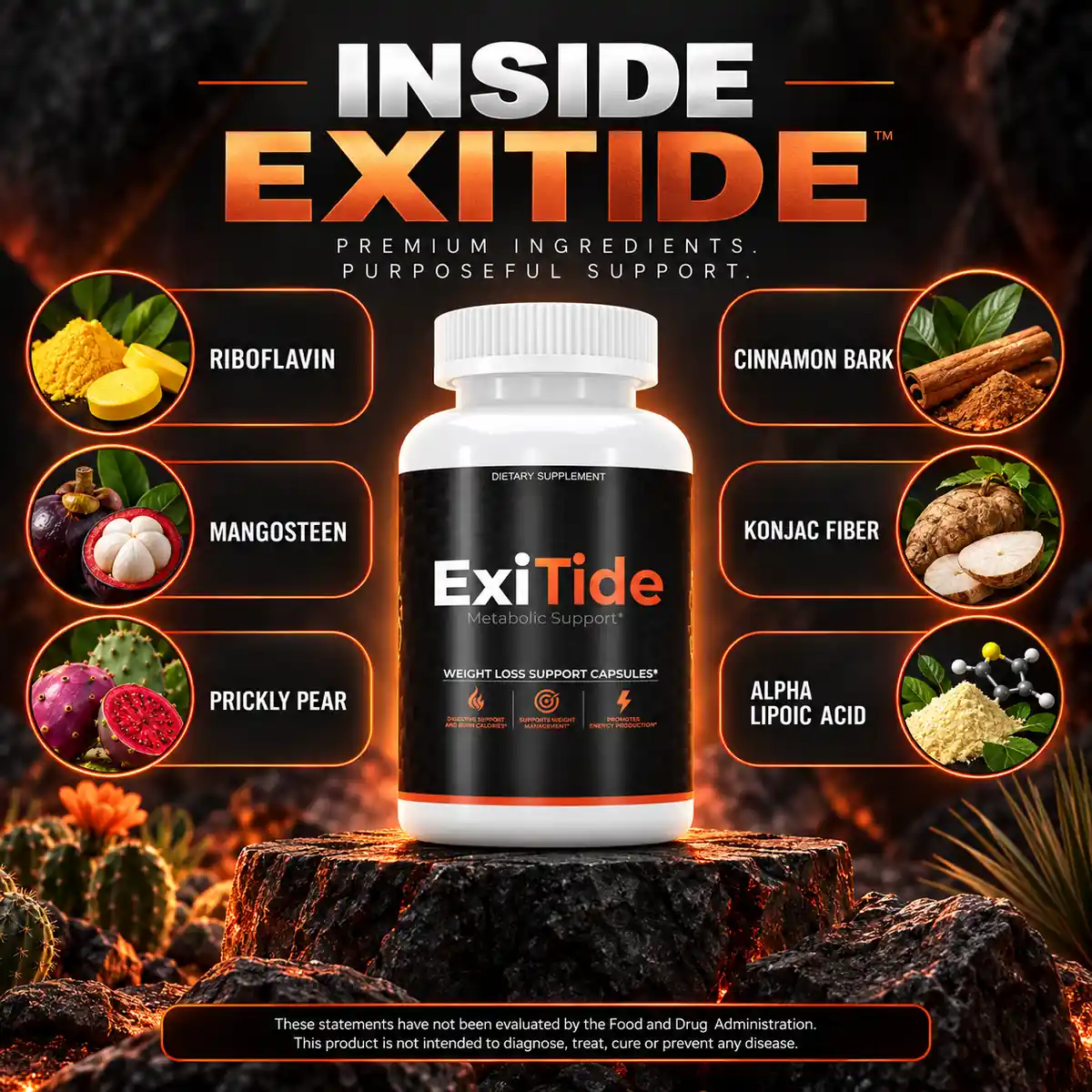
The ExiTide panel names eleven ingredients and prints an amount beside every one. Three sit at 100 mg: mangosteen powder, prickly pear extract 4:1 and cinnamon bark extract 10:1. Riboflavin is 25 mg, konjac fibre 50 mg, and two live cultures are counted at 1 billion CFU each. One capsule is one serving.
What is in ExiTide, ingredient by ingredient
| Ingredient | Amount per capsule | What the wording tells you |
|---|---|---|
| Riboflavin (Vitamin B2) | 25 mg | The only row on the panel with a percentage beside it, because riboflavin is a vitamin with an established Daily Value. 25 mg is 1,470% of it. |
| Mangosteen Powder | 100 mg | Whole powder rather than an extract, so the panel figure is the weight of the powder itself. No extract ratio is printed, because there is none to print. |
| Prickly Pear Extract Powder 4:1 | 100 mg | A 4:1 extract: four parts raw material concentrated into one part powder. The 100 mg is the finished extract, not the raw plant. |
| Cinnamon Bark Extract 10:1 | 100 mg | A 10:1 extract. The panel does not say which cinnamon species, and the two sold as cinnamon differ in their coumarin content. |
| Konjac Extract Fiber (Std. 90% Glucomannan) | 50 mg | Standardised, so the panel states what is in it: 90% of the 50 mg is glucomannan, which is 45 mg of the fibre itself. |
| Alpha Lipoic Acid | 25 mg | A single compound, so 25 mg is 25 mg with nothing to convert. |
| Turmeric Extract (Std. 95% Curcumin) | 15 mg | Standardised to 95% curcuminoids, so the panel's 15 mg carries about 14 mg of curcumin. |
| Berberine HCL | 15 mg | The hydrochloride salt, which is the form almost every berberine study used. |
| Resveratrol Extract (Std. 20% from Polygonum Cuspidatum) | 12 mg | Standardised to 20%, so the 12 mg of extract carries about 2.4 mg of resveratrol. |
| Bifidobacterium Breve | 1 billion CFU | A live culture, counted in colony-forming units rather than weighed in milligrams. The panel prints no strain designation. |
| Akkermansia Muciniphila | 1 billion CFU | The second live culture, also at 1 billion CFU and also without a strain designation. It is an unusual name to find on a retail panel. |
Other ingredients: Hypromellose (capsule), rice flour, silicon dioxide, magnesium stearate.
What each ExiTide ingredient is, and the amount the research used
What each ingredient is, what the research on it found, and the amount that research used. None of these studies tested ExiTide — they tested single ingredients.
Riboflavin (vitamin B2), 25 mg
A water-soluble B vitamin the body converts into two coenzymes, FMN and FAD, which the NIH fact sheet on riboflavin describes as playing major roles in energy production and in the metabolism of fats. The adult recommended intake is 1.3 mg a day for men and 1.1 mg for women aged 19 to 50, and no upper intake level has ever been set.
Mangosteen powder, 100 mg
Dried fruit rather than a standardised extract, so the 100 mg is the weight of the powder itself. In Watanabe 2018, a 26-week mangosteen pilot trial, HOMA-IR — a measure of insulin resistance — fell 53.22% in the mangosteen arm against 15.23% on behavioural therapy alone. That trial used 400 mg a day of a fruit-pulp extract titrated to 40% mangostins.
Prickly pear extract 4:1, 100 mg
Cactus pear concentrated four parts plant to one part powder, so roughly 400 mg of plant stands behind the row. Godard 2010, a 16-week prickly pear extract trial gave pre-diabetic adults 200 mg a day for 16 weeks and found no between-group difference in glucose tolerance or body composition. Onakpoya 2015, a meta-analysis of cactus pear pooled five trials and reported lower BMI, body fat percentage and blood pressure.
Cinnamon bark extract 10:1, 100 mg
Ten parts bark to one part powder, so about a gram of bark stands behind the 100 mg. Allen 2013, a meta-analysis of cinnamon pooled ten trials in 543 people at 120 mg to 6 g a day for four to eighteen weeks: fasting plasma glucose was 24.59 mg/dL lower, with cholesterol and triglycerides also down. HbA1c did not move significantly.
Konjac extract fibre, 50 mg at 90% glucomannan
45 mg of a soluble fibre from konjac root which, the NIH fact sheet on weight-loss supplements says, can absorb up to fifty times its weight in water. the CDC page on dietary fibre describes the result: soluble fibre dissolves, forms a gel in the stomach and slows digestion down. The trials that fact sheet summarises used 1.24 to 3.99 g a day.
Alpha lipoic acid, 25 mg
A sulphur compound the body also makes for itself, and a cofactor for several mitochondrial enzymes. 25 mg is 25 mg, with nothing to convert. Its largest evidence base is in diabetic nerve pain, where the 2024 Cochrane review of alpha lipoic acid read three trials in 816 people and concluded it probably has little or no effect on symptoms. Kucukgoncu 2017, a meta-analysis of alpha lipoic acid and body weight pooled ten trials using 300 mg to 1,800 mg a day.
Turmeric extract, 15 mg at 95% curcumin
About 14 mg of curcuminoids, the root’s yellow pigments. Akbari 2019, a meta-analysis of curcumin and body weight pooled 21 studies in 1,604 people and reported small reductions in BMI, body weight and waist circumference, at curcuminoid amounts running from 80 mg a day up to 1,890 mg. NCCIH on turmeric is blunter: we do not know enough to conclude that curcumin is beneficial for any health purpose.
Berberine HCl, 15 mg
The hydrochloride salt, the form nearly every berberine study used. Guo 2021, a meta-analysis of berberine pooled 46 randomised trials in type 2 diabetes and found HbA1c 0.73 points lower and fasting glucose 0.86 mmol/L lower, mostly as an addition to standard treatment. NCCIH on berberine names the amount that mattered: more than a gram a day, for more than eight weeks.
Resveratrol extract, 12 mg at 20%
2.4 mg of resveratrol, extracted from Japanese knotweed. Timmers 2011, a 30-day resveratrol trial in obese men gave eleven obese men 150 mg a day for thirty days and found AMPK activation, higher SIRT1 and PGC-1 alpha, and better mitochondrial function in muscle. Zeraattalab-Motlagh 2021, an umbrella review of resveratrol, reading 38 meta-analyses, concluded that current evidence does not support resveratrol for cardiometabolic risk factors.
The probiotics in ExiTide, and what a CFU count does and does not say
A colony-forming unit is one organism capable of multiplying, so cultures are counted rather than weighed: the useful question is how many are still alive at the end of shelf life. Both rows here are 1 billion CFU.
Bifidobacterium breve is a common gut resident and one of the first species to colonise a newborn. The trial cited for it is Minami 2018, a trial of Bifidobacterium breve B-3: 80 pre-obese adults over twelve weeks at 20 billion CFU a day of the named strain B-3, run by the company that owns that strain. This panel names the species without a strain code.
Akkermansia muciniphila is the unusual name to find on a retail panel. Derrien 2004, the paper that first described Akkermansia muciniphila described it as a strictly anaerobic gut bacterium living in the mucus layer along the gut wall and using that mucin as its only food, which is where the second half of the name comes from. Depommier 2019, the first human trial of Akkermansia muciniphila was the first human trial: 10 billion a day for three months, with insulin sensitivity up 28.62% in the arm given the pasteurised bacterium.
Both rows live inside one definition, the ISAPP consensus statement on what a probiotic is: live microorganisms which, in adequate amounts, confer a health benefit on the host. Adequate is settled strain by strain.
What the extract ratios on the ExiTide label actually mean
A 4:1 or 10:1 ratio says how much raw plant went into the powder, not how much of any one compound came out. A standardisation is the stronger statement: it names the compound and the percentage.
ExiTide carries both kinds. Konjac fibre is standardised to 90% glucomannan, turmeric to 95% curcumin and resveratrol extract to 20%, which converts to 45 mg, about 14 mg and 2.4 mg of the compounds themselves. Prickly pear and cinnamon bark give a ratio only, and the supplement facts page sets the arithmetic out row by row.
What the 45 mg of fibre in ExiTide looks like beside a day of it
The Dietary Guidelines for Americans put adult fibre intake at 22 to 34 grams a day (the CDC page on dietary fibre). One capsule’s 45 mg of glucomannan is about one five-hundredth of the low end of that range, so the fibre on this panel is a mechanism rather than a supply — a bowl of oats, a pear and a cup of beans do the supplying. What 45 mg does is take up many times its own weight on a fairly empty stomach, which is the reason it goes in ahead of the food.
ExiTide ingredient questions, answered
Which ExiTide ingredient is present in the largest amount?
Three share the top line at 100 mg each: mangosteen powder, prickly pear extract 4:1 and cinnamon bark extract 10:1.
Does ExiTide contain a stimulant?
No. The eleven rows are a vitamin, four plant extracts, a soluble fibre, alpha lipoic acid, berberine, resveratrol and two live cultures, which is also why there is no first-day effect to look for.
Are the ExiTide probiotic strains named?
The panel names both species, Bifidobacterium breve and Akkermansia muciniphila, at 1 billion CFU each, and probiotic research is strain-specific.
How this desk reads the ExiTide label
This desk publishes what the label prints and says plainly where a figure is not published. The four claims below are the ones a sceptical reader can audit in ten minutes, which is the only reason to make them:
- The printed panel is the source. Every amount on this website is read off the ExiTide Supplement Facts panel in the seller’s own label artwork, in the panel’s order and the panel’s wording. Prices come from the seller’s order page, read on 18 September 2026, not from a review column.
- Nothing is rounded up or filled in. A 10:1 extract is printed as a 10:1 extract; a standardised percentage is carried through to the milligrams it represents; a live culture is printed in colony-forming units because that is how the panel counts it.
- Sources are real and linked in the sentence. Every study cited here was confirmed against its PubMed record before it was written down, and every government page was opened and checked by its title rather than assumed.
- Corrections change the date. Write to [email protected] and the review date at the foot of the page moves forward.
We earn when you buy. Getexitide is the USA Authorized Exitide Retailer named at the top of this page, and this website makes money on orders placed through it. That is exactly why the dose comparison, the three-star reviews and the six-of-eight reviewers who wanted more in week one are printed here: they are where our interest and yours pull apart, and you should be able to watch us choose.
Order support on +1 (302) 200-3480 and [email protected] handles tracking, changes, cancellations and refunds. It is not a sales line, and this website never presents it as a way to place an order: orders go through the checkout only.
Sources cited on this ExiTide page
- NIH Office of Dietary Supplements. Riboflavin: Fact Sheet for Health Professionals. https://ods.od.nih.gov/factsheets/Riboflavin-HealthProfessional/
- Watanabe M, Gangitano E, Francomano D, et al. Mangosteen Extract Shows a Potent Insulin Sensitizing Effect in Obese Female Patients: A Prospective Randomized Controlled Pilot Study. Nutrients. 2018;10(5):586. https://pubmed.ncbi.nlm.nih.gov/29747432/
- Onakpoya IJ, O'Sullivan J, Heneghan CJ. The effect of cactus pear (Opuntia ficus-indica) on body weight and cardiovascular risk factors: a systematic review and meta-analysis of randomized clinical trials. Nutrition. 2015;31(5):640-6. https://pubmed.ncbi.nlm.nih.gov/25837206/
- Godard MP, Ewing BA, Pischel I, Ziegler A, Benedek B, Feistel B. Acute blood glucose lowering effects and long-term safety of OpunDia supplementation in pre-diabetic males and females. J Ethnopharmacol. 2010;130(3):631-4. https://pubmed.ncbi.nlm.nih.gov/20621660/
- Allen RW, Schwartzman E, Baker WL, Coleman CI, Phung OJ. Cinnamon use in type 2 diabetes: an updated systematic review and meta-analysis. Ann Fam Med. 2013;11(5):452-9. https://pubmed.ncbi.nlm.nih.gov/24019277/
- NIH Office of Dietary Supplements. Dietary Supplements for Weight Loss: Fact Sheet for Health Professionals. https://ods.od.nih.gov/factsheets/WeightLoss-HealthProfessional/
- Centers for Disease Control and Prevention. Fiber: The Carb That Helps You Manage Diabetes. https://www.cdc.gov/diabetes/healthy-eating/fiber-helps-diabetes.html
- Baicus C, Purcarea A, von Elm E, Delcea C, Furtunescu FL. Alpha-lipoic acid for diabetic peripheral neuropathy. Cochrane Database Syst Rev. 2024;1(1):CD012967. https://pubmed.ncbi.nlm.nih.gov/38205823/
- Kucukgoncu S, Zhou E, Lucas KB, et al. Alpha-lipoic acid (ALA) as a supplementation for weight loss: results from a meta-analysis of randomized controlled trials. Obes Rev. 2017;18(5):594-601. https://pubmed.ncbi.nlm.nih.gov/28295905/
- Akbari M, Lankarani KB, Tabrizi R, et al. The Effects of Curcumin on Weight Loss Among Patients With Metabolic Syndrome and Related Disorders: A Systematic Review and Meta-Analysis of Randomized Controlled Trials. Front Pharmacol. 2019;10:649. https://pubmed.ncbi.nlm.nih.gov/31249528/
- National Center for Complementary and Integrative Health. Turmeric: Usefulness and Safety. https://www.nccih.nih.gov/health/turmeric
- Guo J, Chen H, Zhang X, et al. The Effect of Berberine on Metabolic Profiles in Type 2 Diabetic Patients: A Systematic Review and Meta-Analysis of Randomized Controlled Trials. Oxid Med Cell Longev. 2021;2021:2074610. https://pubmed.ncbi.nlm.nih.gov/34956436/
- National Center for Complementary and Integrative Health. Berberine and Weight Loss: What You Need To Know. https://www.nccih.nih.gov/health/berberine-and-weight-loss-what-you-need-to-know
- Zeraattalab-Motlagh S, Jayedi A, Shab-Bidar S. The effects of resveratrol supplementation in patients with type 2 diabetes, metabolic syndrome, and nonalcoholic fatty liver disease: an umbrella review of meta-analyses of randomized controlled trials. Am J Clin Nutr. 2021;114(5):1675-1685. https://pubmed.ncbi.nlm.nih.gov/34320173/
- Timmers S, Konings E, Bilet L, et al. Calorie restriction-like effects of 30 days of resveratrol supplementation on energy metabolism and metabolic profile in obese humans. Cell Metab. 2011;14(5):612-22. https://pubmed.ncbi.nlm.nih.gov/22055504/
- Minami J, Iwabuchi N, Tanaka M, et al. Effects of Bifidobacterium breve B-3 on body fat reductions in pre-obese adults: a randomized, double-blind, placebo-controlled trial. Biosci Microbiota Food Health. 2018;37(3):67-75. https://pubmed.ncbi.nlm.nih.gov/30094122/
- Depommier C, Everard A, Druart C, et al. Supplementation with Akkermansia muciniphila in overweight and obese human volunteers: a proof-of-concept exploratory study. Nat Med. 2019;25(7):1096-1103. https://pubmed.ncbi.nlm.nih.gov/31263284/
- Derrien M, Vaughan EE, Plugge CM, de Vos WM. Akkermansia muciniphila gen. nov., sp. nov., a human intestinal mucin-degrading bacterium. Int J Syst Evol Microbiol. 2004;54(Pt 5):1469-1476. https://pubmed.ncbi.nlm.nih.gov/15388697/
- Hill C, Guarner F, Reid G, et al. Expert consensus document. The International Scientific Association for Probiotics and Prebiotics consensus statement on the scope and appropriate use of the term probiotic. Nat Rev Gastroenterol Hepatol. 2014;11(8):506-14. https://pubmed.ncbi.nlm.nih.gov/24912386/
More about ExiTide
Order ExiTide from the desk that prints the panel
Eleven named ingredients, every amount printed, one capsule a day and sixty days to change your mind.
$49 to $79 a bottle · 60 days to change your mind
Order ExiTide On The Official Website60-day money-back guarantee · lot EXI-26/GE-7602 · prices read on 18 September 2026