ExiTide Official Website › How ExiTide Works
How Does ExiTide Work?
ExiTide is one capsule taken 15 to 30 minutes before a meal. The eleven ingredients fall into four groups: riboflavin, four plant extracts, a soluble fibre standardised to 90% glucomannan, and two live cultures at 1 billion CFU each. Buyers on this desk's record describe four to eight weeks before judging it.
The four groups on the ExiTide panel
A B vitamin
Riboflavin 25 mg, with an established role in energy metabolism, which is why it carries a percent Daily Value where the botanicals do not.
Four plant extracts
Mangosteen, prickly pear 4:1, cinnamon bark 10:1 and turmeric at 95% curcumin, plus berberine HCl and resveratrol extract.
A soluble fibre
Konjac extract fibre 50 mg, standardised to 90% glucomannan, which takes up water — hence the capsule before a meal, and the full glass.
Two live cultures
Bifidobacterium breve and Akkermansia muciniphila, 1 billion CFU each, counted rather than weighed.
The four routes the ExiTide panel is built around
Water, ahead of the meal
The konjac fibre is standardised to 90% glucomannan, and the NIH says that fibre can absorb up to fifty times its weight in water (the NIH fact sheet on weight-loss supplements). CDC describes the result in the stomach: soluble fibre dissolves, forms a gel and slows digestion down, and because it is not digested it keeps you feeling full for longer (the CDC page on dietary fibre). That is why the capsule goes in front of food rather than after it.
Plant extracts, into the meal that follows
Four rows are plant material with a trial record in glucose handling. Cinnamon is the one whose studied range contains this panel’s amount: ten trials between 120 mg and 6 g a day found fasting plasma glucose 24.59 mg/dL lower (Allen 2013, a meta-analysis of cinnamon). Berberine has the bigger record, 46 randomised trials in type 2 diabetes (Guo 2021, a meta-analysis of berberine) — at amounts far above the 15 mg here.
A vitamin the enzymes need
Riboflavin becomes FMN and FAD, the two coenzymes that carry electrons through the reactions releasing energy from carbohydrate, fat and protein (the NIH fact sheet on riboflavin). That is housekeeping rather than stimulation: more of it than the enzymes need does not make them work faster.
Two organisms, on the mucus layer
Akkermansia muciniphila lives in the mucus lining the gut wall and feeds on it, which is how it was first described (Derrien 2004, the paper that first described Akkermansia muciniphila). Bifidobacterium breve ferments in the same neighbourhood. Both are counted rather than weighed, and both are taken daily: a probiotic is defined by adequate amounts administered (the ISAPP consensus statement on what a probiotic is).
What happens after an ExiTide capsule is swallowed
- The shell goes first. Hypromellose is a plant cellulose film that softens in stomach fluid over a few minutes — releasing a powder rather than a liquid.
- The fibre wets. 45 mg of glucomannan begins taking up water straight away, which is what the full glass is for and what the fifteen to thirty minutes exist to allow.
- The vitamin passes through. Riboflavin absorption from a single dose is limited above roughly 27 mg and the surplus is excreted (the NIH fact sheet on riboflavin), so part of a 25 mg row can leave in the urine within hours, sometimes visibly. That is absorption, not effect.
- The extracts disperse into the meal. Plant compounds of this kind are absorbed alongside food — a second reason the capsule is tied to a meal rather than a clock time.
- The cultures travel. Live organisms have to survive the stomach to reach the part of the gut they live in, which is why the count is repeated daily rather than taken once.
Why the ExiTide label puts the capsule before a meal
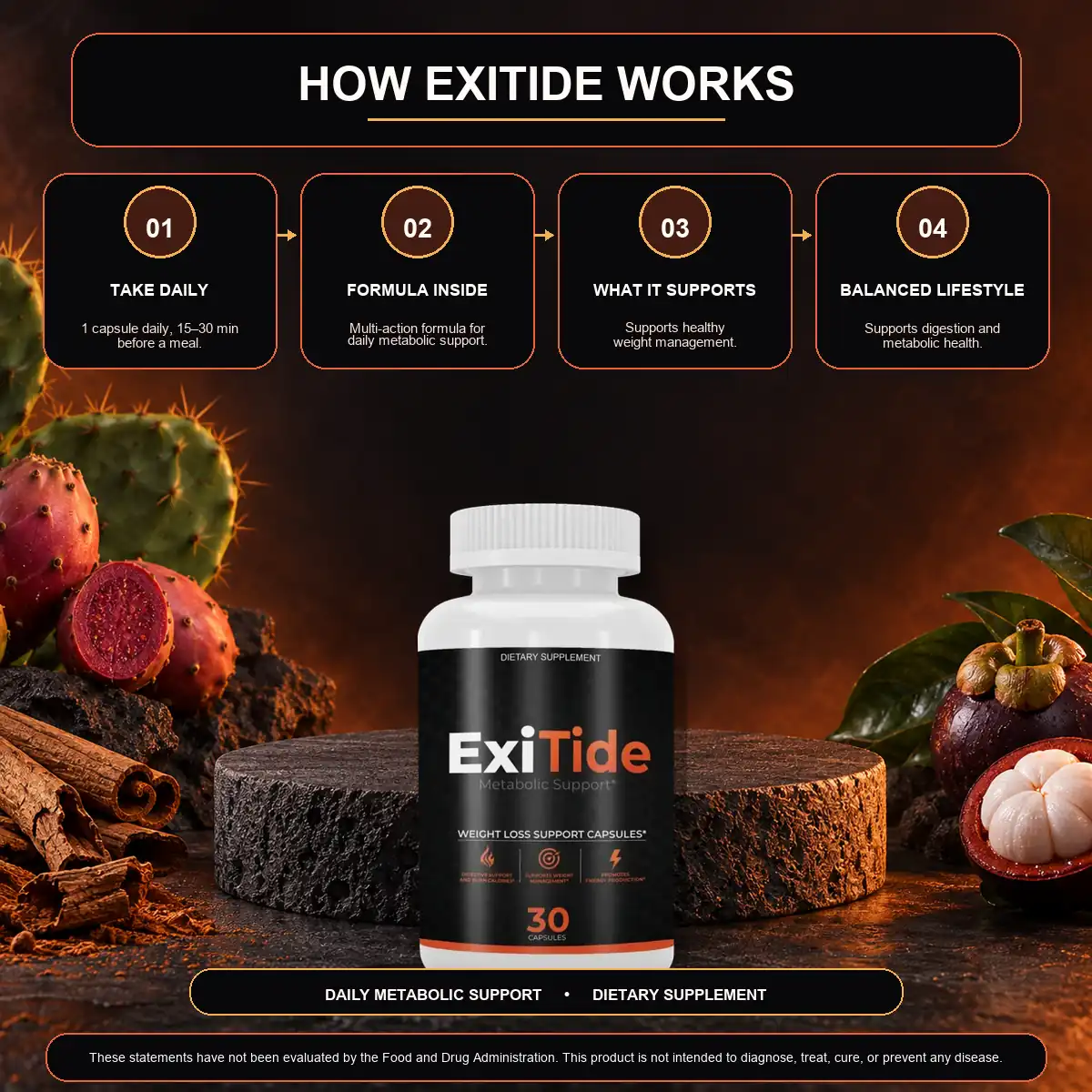
Fifteen to thirty minutes is long enough for a capsule shell to open and for a gel-forming fibre to start taking up water, and short enough that the meal arrives while that is still happening. Taken with food, the same fibre disperses into the meal instead of ahead of it; taken hours before, it has already moved on.
The label sets a window rather than a clock time and names no particular meal, so anchor it to the one you never skip. The dosing page carries the practical version, including what to do about a missed day.
How ExiTide is dosed against the amounts the research used
| Panel row | One capsule gives | What the research used | How the two compare |
|---|---|---|---|
| Konjac extract fibre (90% glucomannan) 50 mg | 45 mg of glucomannan | 1.24 to 3.99 g a day in the trials ODS summarises (the NIH fact sheet) | about one twenty-eighth of the smallest trial dose, and about one eighty-ninth of the largest |
| Berberine HCl 15 mg | 15 mg of berberine | more than 1 g a day for more than eight weeks, where NCCIH says the weight effects were seen (NCCIH) | about one sixty-seventh of that threshold |
| Resveratrol extract (20%) 12 mg | 2.4 mg of resveratrol | 150 mg a day for 30 days (Timmers 2011) | about one sixty-third of the trial dose |
| Turmeric extract (95% curcumin) 15 mg | about 14 mg of curcumin | 80 mg a day at the very lowest, in a nano-curcumin, and 1,000 mg a day most commonly (Akbari 2019) | roughly one sixth of the lowest dose in the meta-analysis and about one seventieth of the usual one |
| Alpha lipoic acid 25 mg | 25 mg | 300 mg to 1,800 mg a day (Kucukgoncu 2017) | about one twelfth of the smallest trial dose |
| Bifidobacterium breve 1 billion CFU | 1 billion CFU, with no strain named on the label | 20 billion CFU a day of the named strain B-3 (Minami 2018) | one twentieth of the trial amount, and of an unnamed strain rather than the one that was tested |
| Akkermansia muciniphila 1 billion CFU | 1 billion CFU | 10 billion a day, and the metabolic improvements were reported for the pasteurised form (Depommier 2019) | one tenth of the trial amount |
| Mangosteen powder 100 mg | 100 mg of fruit powder | 400 mg a day of an extract standardised to 40% mangostins (Watanabe 2018) | a quarter of the mass, and a powder rather than a standardised extract |
| Prickly pear extract 4:1, 100 mg | 100 mg of a 4:1 extract, equivalent to about 400 mg of the plant | 200 mg a day of an Opuntia extract for 16 weeks, which changed nothing between groups (Godard 2010) | the same order of magnitude as the trial dose; the trial found no between-group difference at it |
| Cinnamon bark extract 10:1, 100 mg | 100 mg of a 10:1 extract, equivalent to about 1 g of bark | 120 mg to 6 g a day (Allen 2013) | inside the studied range, and the only item on this panel that is |
| Vitamin B2 (riboflavin) 25 mg | 25 mg | an RDA of 1.3 mg for men and 1.1 mg for women (the NIH riboflavin sheet) | about nineteen times the adult male RDA; there is no upper limit set for riboflavin, and absorption is limited above roughly 27 mg in one dose |
Nine rows sit below the amounts the studies used, one sits inside them, and the vitamin is measured against a recommended intake rather than a trial.
The cinnamon row is the counterweight and deserves stating plainly: 100 mg of a 10:1 bark extract is about a gram of bark, and the range Allen pooled runs from 120 mg to 6 g a day (Allen 2013, a meta-analysis of cinnamon). That is inside the studied range, and it is the only row here that is.
The four largest gaps are berberine, resveratrol, alpha lipoic acid and the konjac fibre. NCCIH puts berberine’s threshold at more than a gram a day for more than eight weeks (NCCIH on berberine) and this capsule carries 15 mg. The resveratrol trial most often quoted used 150 mg a day (Timmers 2011, a 30-day resveratrol trial in obese men) against 2.4 mg here. Alpha lipoic acid was trialled at 300 mg to 1,800 mg a day (Kucukgoncu 2017, a meta-analysis of alpha lipoic acid and body weight) against 25 mg. The glucomannan trials used grams, 1.24 to 3.99 a day (the NIH fact sheet on weight-loss supplements), against 45 mg.
That resveratrol trial is also the only paper cited here that measured metabolic rate directly, and what it found was resveratrol lowering sleeping and resting metabolic rate. So resveratrol is not described as a metabolism booster here, at 2.4 mg or at any other amount.
The two cultures are a different kind of distance — not only smaller, but not quite the same material. The B. breve body-fat trial used 20 billion CFU a day of one named strain, B-3 (Minami 2018, a trial of Bifidobacterium breve B-3), and this label names the species without a strain code. The Akkermansia findings that reached significance were in the arm given the pasteurised organism at 10 billion a day (Depommier 2019, the first human trial of Akkermansia muciniphila), and a live culture is a different thing from a pasteurised one.
No trial of the finished formula has been published, so nothing here can tell you what eleven ingredients do together. What can be told is what each one is, how much of it a capsule carries, and what the research on it used.
Who writes the ExiTide mechanism pages
This desk publishes what the label prints and says plainly where a figure is not published. The four claims below are the ones a sceptical reader can audit in ten minutes, which is the only reason to make them:
- The printed panel is the source. Every amount on this website is read off the ExiTide Supplement Facts panel in the seller’s own label artwork, in the panel’s order and the panel’s wording. Prices come from the seller’s order page, read on 18 September 2026, not from a review column.
- Nothing is rounded up or filled in. A 10:1 extract is printed as a 10:1 extract; a standardised percentage is carried through to the milligrams it represents; a live culture is printed in colony-forming units because that is how the panel counts it.
- Sources are real and linked in the sentence. Every study cited here was confirmed against its PubMed record before it was written down, and every government page was opened and checked by its title rather than assumed.
- Corrections change the date. Write to [email protected] and the review date at the foot of the page moves forward.
We earn when you buy. Getexitide is the USA Authorized Exitide Retailer named at the top of this page, and this website makes money on orders placed through it. That is exactly why the dose comparison, the three-star reviews and the six-of-eight reviewers who wanted more in week one are printed here: they are where our interest and yours pull apart, and you should be able to watch us choose.
Order support on +1 (302) 200-3480 and [email protected] handles tracking, changes, cancellations and refunds. It is not a sales line, and this website never presents it as a way to place an order: orders go through the checkout only.
Sources cited on this ExiTide page
- NIH Office of Dietary Supplements. Riboflavin: Fact Sheet for Health Professionals. https://ods.od.nih.gov/factsheets/Riboflavin-HealthProfessional/
- Watanabe M, Gangitano E, Francomano D, et al. Mangosteen Extract Shows a Potent Insulin Sensitizing Effect in Obese Female Patients: A Prospective Randomized Controlled Pilot Study. Nutrients. 2018;10(5):586. https://pubmed.ncbi.nlm.nih.gov/29747432/
- Godard MP, Ewing BA, Pischel I, Ziegler A, Benedek B, Feistel B. Acute blood glucose lowering effects and long-term safety of OpunDia supplementation in pre-diabetic males and females. J Ethnopharmacol. 2010;130(3):631-4. https://pubmed.ncbi.nlm.nih.gov/20621660/
- Allen RW, Schwartzman E, Baker WL, Coleman CI, Phung OJ. Cinnamon use in type 2 diabetes: an updated systematic review and meta-analysis. Ann Fam Med. 2013;11(5):452-9. https://pubmed.ncbi.nlm.nih.gov/24019277/
- NIH Office of Dietary Supplements. Dietary Supplements for Weight Loss: Fact Sheet for Health Professionals. https://ods.od.nih.gov/factsheets/WeightLoss-HealthProfessional/
- Centers for Disease Control and Prevention. Fiber: The Carb That Helps You Manage Diabetes. https://www.cdc.gov/diabetes/healthy-eating/fiber-helps-diabetes.html
- Kucukgoncu S, Zhou E, Lucas KB, et al. Alpha-lipoic acid (ALA) as a supplementation for weight loss: results from a meta-analysis of randomized controlled trials. Obes Rev. 2017;18(5):594-601. https://pubmed.ncbi.nlm.nih.gov/28295905/
- Akbari M, Lankarani KB, Tabrizi R, et al. The Effects of Curcumin on Weight Loss Among Patients With Metabolic Syndrome and Related Disorders: A Systematic Review and Meta-Analysis of Randomized Controlled Trials. Front Pharmacol. 2019;10:649. https://pubmed.ncbi.nlm.nih.gov/31249528/
- Guo J, Chen H, Zhang X, et al. The Effect of Berberine on Metabolic Profiles in Type 2 Diabetic Patients: A Systematic Review and Meta-Analysis of Randomized Controlled Trials. Oxid Med Cell Longev. 2021;2021:2074610. https://pubmed.ncbi.nlm.nih.gov/34956436/
- National Center for Complementary and Integrative Health. Berberine and Weight Loss: What You Need To Know. https://www.nccih.nih.gov/health/berberine-and-weight-loss-what-you-need-to-know
- Timmers S, Konings E, Bilet L, et al. Calorie restriction-like effects of 30 days of resveratrol supplementation on energy metabolism and metabolic profile in obese humans. Cell Metab. 2011;14(5):612-22. https://pubmed.ncbi.nlm.nih.gov/22055504/
- Minami J, Iwabuchi N, Tanaka M, et al. Effects of Bifidobacterium breve B-3 on body fat reductions in pre-obese adults: a randomized, double-blind, placebo-controlled trial. Biosci Microbiota Food Health. 2018;37(3):67-75. https://pubmed.ncbi.nlm.nih.gov/30094122/
- Depommier C, Everard A, Druart C, et al. Supplementation with Akkermansia muciniphila in overweight and obese human volunteers: a proof-of-concept exploratory study. Nat Med. 2019;25(7):1096-1103. https://pubmed.ncbi.nlm.nih.gov/31263284/
- Derrien M, Vaughan EE, Plugge CM, de Vos WM. Akkermansia muciniphila gen. nov., sp. nov., a human intestinal mucin-degrading bacterium. Int J Syst Evol Microbiol. 2004;54(Pt 5):1469-1476. https://pubmed.ncbi.nlm.nih.gov/15388697/
- Hill C, Guarner F, Reid G, et al. Expert consensus document. The International Scientific Association for Probiotics and Prebiotics consensus statement on the scope and appropriate use of the term probiotic. Nat Rev Gastroenterol Hepatol. 2014;11(8):506-14. https://pubmed.ncbi.nlm.nih.gov/24912386/
More about ExiTide
Order ExiTide from the desk that prints the panel
Eleven named ingredients, every amount printed, one capsule a day and sixty days to change your mind.
$49 to $79 a bottle · 60 days to change your mind
Order ExiTide On The Official Website60-day money-back guarantee · lot EXI-26/GE-7602 · prices read on 18 September 2026