ExiTide Official Website › Reference Guides
Reference Guides From This Desk
Two guides, written to be useful whether or not you buy anything here. The first explains how a metabolism supplement panel is put together and what an extract ratio, a standardisation and a CFU count each mean. The second is a checklist for choosing one, with this product scored against it.
The two guides
Metabolism supplement guide
How a panel is built, what a 10:1 extract actually is, why a standardisation is the stronger statement, and how live cultures are counted.
Choosing a metabolism supplement
A fourteen-row checklist, and this product scored against it, including the six rows it does not pass.
Why a retail desk publishes a reading guide
Most of what is wrong with a metabolism supplement is legible on its own label, to anyone who knows what the numbers are attached to. That is an unusual situation in retail, and it is worth handing over rather than keeping.
A reader who can convert a standardised percentage into milligrams and set the result beside a trial dose will make a better decision about this product, and about the next four they look at. Sometimes that decision is not to buy — which is the honest cost of publishing the method.
Neither guide is a review. The first teaches a skill and the second applies it, and the product this desk sells is scored in public by the same rules as anything else.
The five parts of a Supplement Facts panel
Every panel in this category is the same five parts in the same order. Recognising them takes about a minute and saves a great deal of argument later.
- The heading. The words Supplement Facts, and beneath them the serving size and the servings per container. Nothing below this line makes sense without it.
- The rows. One named ingredient a line, with the amount in one serving beside it. This is where a proprietary blend collapses several names into a single total.
- The right-hand column. A percent Daily Value where a Daily Value exists for that nutrient, and a dagger where none has been set.
- The footnote. What the percentages are calculated against, and what the dagger means, in the panel's own words.
- The other-ingredients line. Everything in the capsule that is not on the panel above: the shell, the filler, the flow agents.
Twelve terms, and what each one settles
| The term | What it means on a panel | What it does not settle |
|---|---|---|
| Serving size | The amount every other figure on the panel is attached to. One capsule here. | How many capsules a day anyone actually takes. |
| Servings per container | How many of those servings the bottle holds. Thirty here, so a bottle is a month. | How long the bottle lasts if the serving is two. |
| Amount per serving | The weight of the named material in one serving, in milligrams. | How much of it survives the stomach, or reaches the blood. |
| Extract ratio (4:1, 10:1) | How much raw plant was concentrated into the powder. Ten kilograms into one is 10:1. | Which compound came out, or how much of it. |
| Standardisation (90%, 95%, 20%) | A named compound and the percentage of the extract that is made of it. Multiply and you have the delivered amount. | Whether the batch in your hand was assayed against it. |
| Colony-forming unit | One live organism able to multiply. Live cultures are counted this way rather than weighed, because the consensus definition of a probiotic turns on live microorganisms in adequate amounts. | How many are still alive at the end of the shelf life. |
| Strain designation | The code after the species name, such as B-3, that identifies the exact organism a study used. | Nothing, when it is absent: without it, a species name cannot borrow a strain's evidence. |
| Percent Daily Value | How one serving compares to the reference intake for that nutrient, where one has been set. The riboflavin Daily Value is why this panel carries a 1,470% figure. | Anything about botanicals, which mostly have no Daily Value at all. |
| The dagger | The mark against a row for which no Daily Value has been established. | It is a statement about the regulation, not a judgement on the ingredient. |
| Proprietary blend | One total for a group of ingredients, with the split held back. | How much of each. The total is a ceiling: nothing in the blend can exceed it. |
| Other ingredients | Everything that is in the capsule but is not the point of it: the shell, the filler, the flow agents. | Whether any of them matters to you, which depends on you. |
| Certificate of analysis | A laboratory document with an assay, a method and a date on it. | A reference number quoted on a website is a label marking rather than the document itself. |
Twelve terms cover almost every panel in this category. Both guides below assume them and nothing else.
What a standardised row lets you calculate
The bottle this desk sells prints a standardisation on three of its rows, which is enough to show the whole arithmetic on real numbers. Konjac extract fibre at 50 mg, standardised to 90% glucomannan, delivers about 45 mg of the fibre itself. Turmeric extract at 15 mg, standardised to 95%, delivers about 14 mg of curcuminoids. Resveratrol extract at 12 mg, standardised to 20%, delivers 2.4 mg of resveratrol.
Three multiplications, no estimates, and three figures that can be compared with something — that is the whole trick, and it is why a standardisation is worth more on a label than a ratio, a proprietary blend or a long list of names.
The panel guide works through the rest of it: what a 4:1 and a 10:1 do and do not tell you, how a live culture is counted, and what a good label in this category prints that most of them leave out.
Which guide to read first
Start with the panel guide
If you are holding a bottle, or looking at a listing, and want to know what its numbers actually commit anyone to. It is the longer of the two and the one that teaches the arithmetic.
Start with the checklist
If you have already narrowed the field and want a quick, repeatable way to separate two products. Fourteen questions, answerable from a label and a seller's page in about five minutes.
Read both before a six-month order
The larger the count, the longer the commitment runs past any guarantee window. That is the point at which an hour of reading is cheap.
How the research in these guides was checked
Every study named in either guide was confirmed against its own record before it was written down, on September 18, 2026, and every government page was opened and checked by its title and then by the sentence attributed to it. Where a paper's abstract gave no dose, the full text was read for one rather than a figure being estimated.
None of those papers studied a finished multi-ingredient capsule. They studied single ingredients, mostly at amounts well above what one capsule of anything carries, and several of the strongest among them are null results. A citation in these guides is evidence about an ingredient at a stated amount — and nothing more.
What a supplement is permitted to claim about itself in the first place is set out by the FDA: a structure or function claim describes a normal role in the body, has to be accurate and truthful, and carries the disclaimer at the foot of this page because only a drug may claim to treat anything.
What these guides will not do for you
- ✓They will not tell you whether a supplement works. A label is a specification — reading one carefully is not the same as testing the contents.
- ✓They will not rank brands. The checklist scores a product against fixed questions, and two products can score alike and differ in every way that matters to you.
- ✓They will not settle quality. A registered facility is a listed facility rather than an approved one, and a seal is a claim until a certificate stands behind it.
- ✓They are not advice about your own circumstances, your medication or anything you are being treated for.
- ✓They do not stay right forever. Labels are reformulated and pages are rewritten, so the bottle in your hand outranks anything written here.
Who writes the guides on this website
This desk publishes what the label prints and says plainly where a figure is not published. The four claims below are the ones a sceptical reader can audit in ten minutes, which is the only reason to make them:
- The printed panel is the source. Every amount on this website is read off the ExiTide Supplement Facts panel in the seller’s own label artwork, in the panel’s order and the panel’s wording. Prices come from the seller’s order page, read on 18 September 2026, not from a review column.
- Nothing is rounded up or filled in. A 10:1 extract is printed as a 10:1 extract; a standardised percentage is carried through to the milligrams it represents; a live culture is printed in colony-forming units because that is how the panel counts it.
- Sources are real and linked in the sentence. Every study cited here was confirmed against its PubMed record before it was written down, and every government page was opened and checked by its title rather than assumed.
- Corrections change the date. Write to [email protected] and the review date at the foot of the page moves forward.
We earn when you buy. Getexitide is the USA Authorized Exitide Retailer named at the top of this page, and this website makes money on orders placed through it. That is exactly why the dose comparison, the three-star reviews and the six-of-eight reviewers who wanted more in week one are printed here: they are where our interest and yours pull apart, and you should be able to watch us choose.
Order support on +1 (302) 200-3480 and [email protected] handles tracking, changes, cancellations and refunds. It is not a sales line, and this website never presents it as a way to place an order: orders go through the checkout only.
Sources cited on this ExiTide page
- Hill C, Guarner F, Reid G, et al. Expert consensus document. The International Scientific Association for Probiotics and Prebiotics consensus statement on the scope and appropriate use of the term probiotic. Nat Rev Gastroenterol Hepatol. 2014;11(8):506-14. https://pubmed.ncbi.nlm.nih.gov/24912386/
- NIH Office of Dietary Supplements. Riboflavin: Fact Sheet for Health Professionals. https://ods.od.nih.gov/factsheets/Riboflavin-HealthProfessional/
- U.S. Food and Drug Administration. Structure/Function Claims. https://www.fda.gov/food/nutrition-food-labeling-and-critical-foods/structurefunction-claims
- U.S. Food and Drug Administration. Is It Really 'FDA Approved'? https://www.fda.gov/consumers/consumer-updates/it-really-fda-approved
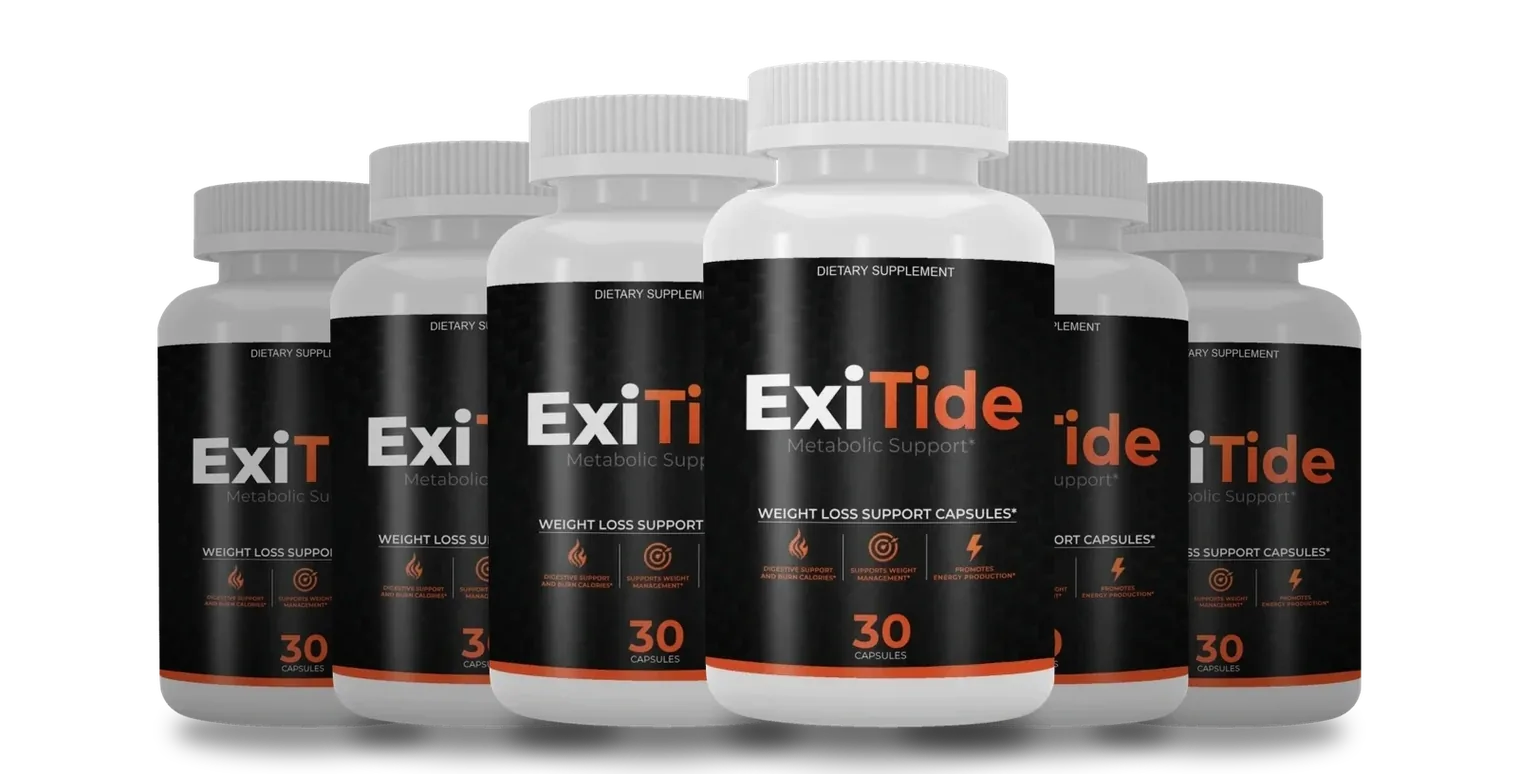
See how ExiTide scores against this checklist
Eleven named ingredients with every amount printed, and nine of them below the amounts the research used. Both facts are on the same page.
$49 to $79 a bottle · 60 days to change your mind
Order ExiTide On The Official Website60-day money-back guarantee · lot EXI-26/GE-7602 · prices read on 18 September 2026