ExiTide Official Website › Blog › Glucomannan at 50 mg
Glucomannan in ExiTide: What 45 mg of Konjac Fibre Can Do
The glucomannan in ExiTide is 50 mg of konjac extract fibre standardised to 90%, which is about 45 mg per capsule. The satiety and weight trials used 1.24 to 3.99 grams a day, so one capsule is a small fraction of that. Take it with a full glass of water, as the label describes.
- The conversion. Konjac extract fibre 50 mg, standardised to 90% glucomannan, is 45 mg of glucomannan.
- The scale. The Dietary Guidelines put an adult day at 22 to 34 grams of fibre. This is about one five-hundredth of the low end.
- The trials. Glucomannan trials ran from 1.24 to 3.99 grams a day, and the pooled result on body weight crosses zero.
- The safety note that is actually useful. The reported obstructions were tablet forms. A capsule goes down with a full glass of water, which is what the mechanism asks for.
The conversion, in one line
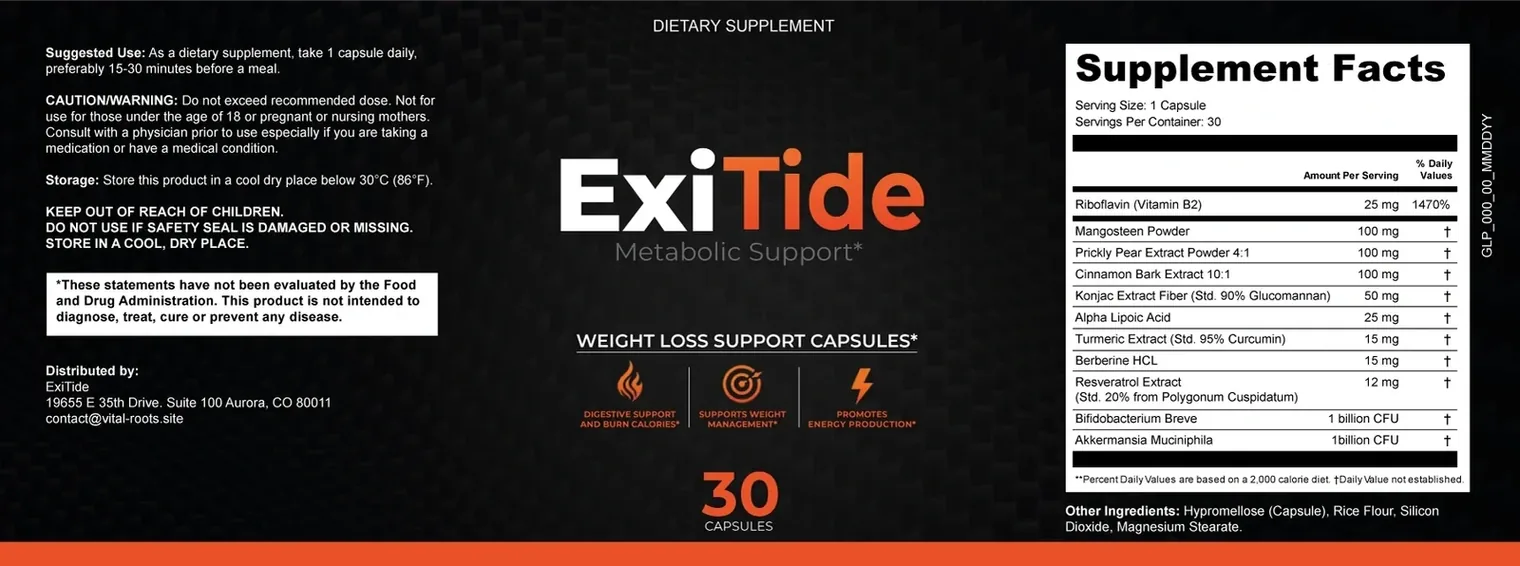
The panel prints Konjac Extract Fiber (Std. 90% Glucomannan) at 50 mg. Ninety per cent of fifty milligrams is forty-five, so one capsule carries about 45 mg of glucomannan and about 5 mg of the rest of the extract. That is the number to search on rather than the 50 mg on the front of the row.
A standardisation names a compound and a percentage, which makes the conversion a single multiplication. Two other rows here are written the same way and two more carry an extract ratio instead, which is weaker. The panel page sets all eleven rows out in the label's own order.
Konjac is a root vegetable — glucomannan is the soluble fibre drawn from it, and the same fibre is what makes shirataki noodles behave the way they do.

What a soluble fibre actually does
The mechanism is not in dispute and is worth stating before any question of amount. CDC puts it in one sentence: soluble fibre dissolves in water and forms a gel-like substance in the stomach, slowing down digestion. Because fibre is not digested it moves slowly through the stomach, which is what people mean when they say it makes you feel fuller for longer.
The NIH fact sheet on weight-loss supplements describes glucomannan as a soluble fibre from konjac root that can absorb up to fifty times its weight in water, and records that it has been proposed to increase satiety and prolong gastric emptying. Proposed is the fact sheet's own word and it is the right one.
So the mechanism is real and well described. The question this article exists to answer is what happens to it at 45 mg.
Forty-five milligrams against a day of fibre
The clearest comparison available is not against a trial dose at all. The Dietary Guidelines for Americans 2020 to 2025 recommend that adults eat 22 to 34 grams of fibre a day depending on age and sex, and that figure is on the same CDC page as the mechanism above.
One capsule carries 45 milligrams. The low end of that daily range is 22 grams, or 22,000 milligrams, so 45 is about one five-hundredth of it. A whole bottle of thirty capsules carries 1.35 grams, still under a tenth of a single day.
That comparison is the fairest on this panel because it is the one a reader can picture. A bowl of oats or a plate of beans is where a day's fibre comes from — this capsule is not.
| Comparison | The amount | Where this capsule sits |
|---|---|---|
| A day of fibre from food, as the Dietary Guidelines describe it | 22 to 34 grams a day for adults | About one five-hundredth of the low end of that range. |
| The glucomannan trials the NIH fact sheet summarises | 1.24 to 3.99 grams a day for up to twelve weeks | About one twenty-eighth of the smallest of them. |
| The older and wider meta-analysis on the same sheet | 1.2 to 15.1 grams a day | About one eighty-ninth of the largest. |
Grams and milligrams are a thousand apart — which is the whole of why these ratios look the way they do. A bottle of thirty capsules carries 1.35 g in total.
What the satiety and weight trials used
Two bodies of evidence matter here and both point the same way. The NIH fact sheet summarises a 2015 review of six randomised trials in 293 people, at 1.24 to 3.99 grams a day for up to twelve weeks, which found no significant effect on body weight. It also describes an older meta-analysis of fourteen studies at 1.2 to 15.1 grams a day, finding a mean loss of 0.79 kg more than placebo over about five weeks. The sheet's own summary line is little to no effect on body weight.
Onakpoya 2014 pooled eight randomised trials independently and reached the same place: a mean difference of minus 0.22 kg, on a 95% confidence interval from minus 0.62 to 0.19. An interval that crosses zero is consistent with no difference at all. Heterogeneity was 65%, and the authors write that the available trials do not show a statistically significant effect on body weight.
Those trials ran at grams a day. This capsule runs at forty-five thousandths of a gram. The gap is large enough that the trials are not evidence about this amount in either direction, and the null results are not evidence against it either.
- Reported adverse events in the pooled trials were abdominal discomfort, diarrhoea and constipation, which is what a fibre at gram doses tends to produce.
- The trials ran for weeks, so none is evidence about an effect after one capsule.
- None tested a fibre alongside ten other ingredients, which is the form it takes here.
- Fibre has real findings on measures other than the scales, worth reading in their own right rather than as a substitute.
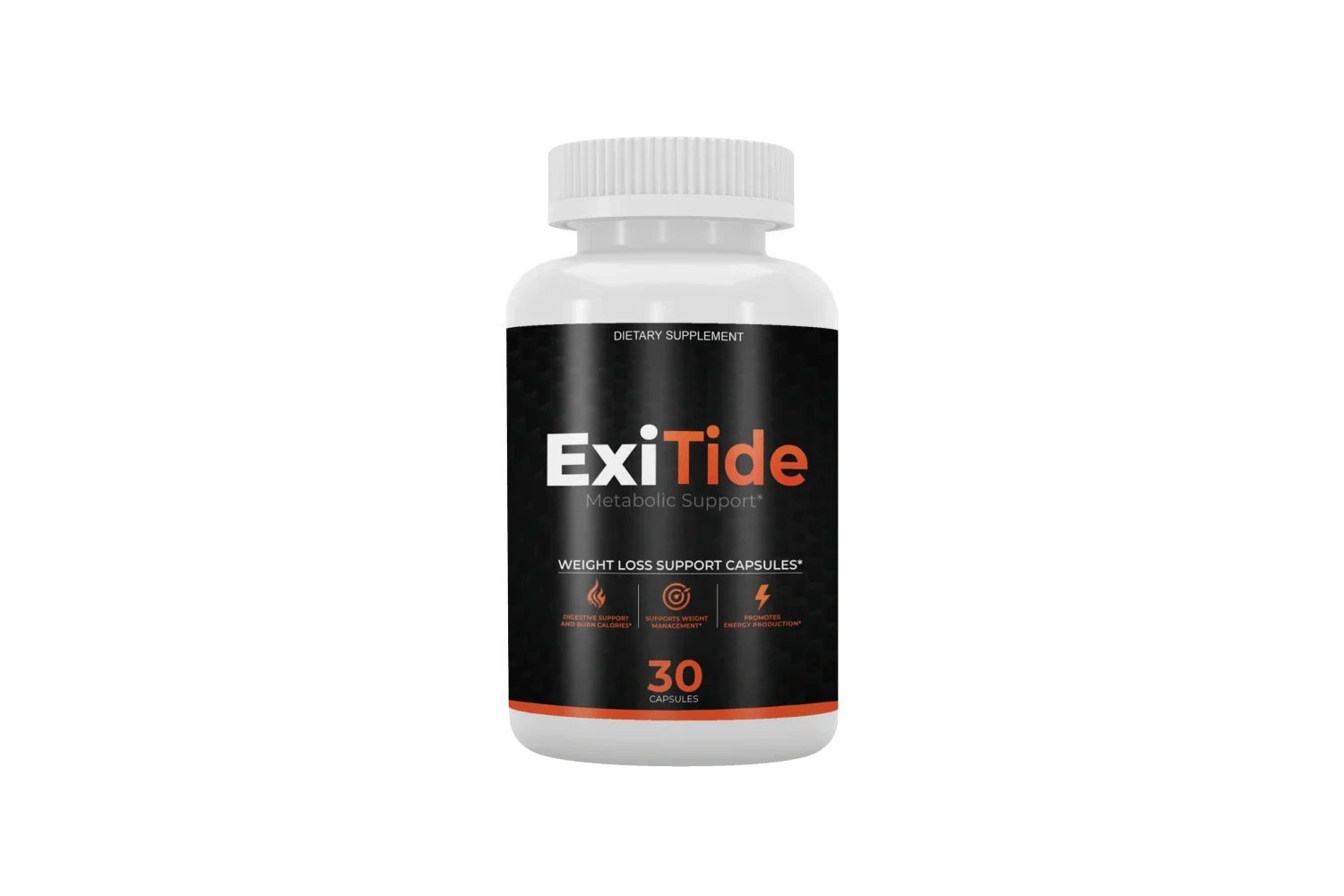
One capsule a day, fifteen to thirty minutes before a meal
Eleven named ingredients with every amount printed, taken with a full glass of water, and sixty days from purchase to change your mind.
$49 to $79 a bottle · 60-day money-back guarantee
Order ExiTideThe other fibre on this panel
Konjac is not the only plant material here with a fibre reputation. Prickly Pear Extract Powder 4:1 sits three rows above it at 100 mg, and cactus pear has its own pooled analysis.
Onakpoya 2015 pooled five randomised trials and found significant reductions in body mass index, percentage body fat, systolic and diastolic blood pressure and total cholesterol. On body weight the pooled difference was minus 0.83 kg on an interval from minus 2.49 to 0.83, which crosses zero, with heterogeneity at 93%. The authors' own conclusion is that the evidence does not indicate a statistically significant effect on body weight. Adverse events included gastric intolerance.
Two fibres, two independent meta-analyses — both null on the scales and both with real findings elsewhere. Printing those sentences together is the only accurate way to describe this part of the panel.
The full glass of water, and why
There is a safety story attached to glucomannan and it is usually told wrongly.
The NIH fact sheet records seven cases of oesophageal obstruction reported with tablet forms in Australia in 1984 and 1985, and then says in its own words that powdered and capsule forms have not been associated with that effect. This product is a capsule carrying 45 mg, so repeating a tablet warning here would be inaccurate in the direction of fear.
Vanderbeek 2007 describes a 37-year-old woman who developed a delayed oesophageal obstruction after taking an over-the-counter diet aid containing glucomannan. The paper explains the mechanism plainly: the fibre is hygroscopic and expands rapidly to many times the size of the original material. On later endoscopy she was found to have an oesophageal web, a pre-existing narrowing, and the authors frame the risk as one in patients with a history of upper gastrointestinal problems. It is one case, at an unstated amount, in a person with a known narrowing.
What falls out of it is the mechanism rather than the warning. A fibre that swells on contact with water should be swallowed with enough of it, so a full glass is the sensible way to take any capsule containing a gelling fibre. Anyone with a known swallowing difficulty has a specific reason to raise it first.
What 45 mg can and cannot be expected to do
The table below is the article in one screen.
| Question | The answer this evidence supports |
|---|---|
| Is glucomannan a soluble fibre that gels in water? | Yes. The NIH describes it as able to absorb up to fifty times its weight in water. |
| Is 45 mg a meaningful contribution to a day's fibre? | No. A day is measured in tens of grams and this in tens of milligrams. |
| Did the pooled trials find an effect on body weight? | No. The eight-trial analysis reports minus 0.22 kg on an interval crossing zero. |
| Does a capsule carry the obstruction risk reported for tablets? | Not on this record. The NIH says powdered and capsule forms have not been associated with that effect. |
| Should it still go down with a full glass of water? | Yes, and that is the practical point. A fibre that swells on contact with water is swallowed with enough of it. |
Each answer is the position of the source linked beside it in the text, restated. Where a source reports a null result, the null result is what is printed.
Taking it, as the label describes
The label's suggested use is one capsule daily, preferably fifteen to thirty minutes before a meal. For a gelling fibre that timing has an obvious logic: it is taken ahead of the food it would slow rather than after it.
- Take it with a full glass of water — not a mouthful. The mechanism is water absorption and the format assumes water is there.
- Fix it to the same meal every day. The reviewers on this desk's record who described a settled routine are the ones who stayed with it, which the timeline article goes through in detail.
- Do not double up to make the fibre figure larger. The label says one capsule a day, and the fibre is the smallest reason to take this capsule rather than the largest.
- If a day's fibre is the actual goal, food is the answer and the comparison above is why. The how-to-use page covers timing and missed days.
What this desk will not say about the fibre row
This website makes money when an order goes through it, so this is where its interest and the reader's pull apart.
- That glucomannan at this amount changes body weight. Two independent meta-analyses are null on that measure at doses many times larger.
- That 45 mg contributes meaningfully to a day's fibre. It is about one five-hundredth of the low end of the daily range.
- That a fibre in a capsule replaces fibre in food.
- That the tablet obstruction cases apply to this format. The source that records them says the opposite.
- That satiety was measured here. The mechanism is described in the fact sheets; the trials at gram doses produced no weight result, and this is a fraction of one.
What is true is short and printed: konjac extract fibre standardised to 90% glucomannan, 50 mg a capsule, 45 mg of the fibre itself, on a panel that names all eleven ingredients. The ingredients page covers the other ten and the pricing page sets out what a month costs.
Sources cited in this article
- Centers for Disease Control and Prevention. Fiber: The Carb That Helps You Manage Diabetes. https://www.cdc.gov/diabetes/healthy-eating/fiber-helps-diabetes.html
- NIH Office of Dietary Supplements. Dietary Supplements for Weight Loss: Fact Sheet for Health Professionals. https://ods.od.nih.gov/factsheets/WeightLoss-HealthProfessional/
- Onakpoya I, Posadzki P, Ernst E. The efficacy of glucomannan supplementation in overweight and obesity: a systematic review and meta-analysis of randomized clinical trials. J Am Coll Nutr. 2014;33(1):70-8. https://pubmed.ncbi.nlm.nih.gov/24533610/
- Vanderbeek PB, Fasano C, O'Malley G, et al. Esophageal obstruction from a hygroscopic pharmacobezoar containing glucomannan. Clin Toxicol (Phila). 2007;45(1):80-2. https://pubmed.ncbi.nlm.nih.gov/17357389/
- Onakpoya IJ, O'Sullivan J, Heneghan CJ. The effect of cactus pear (Opuntia ficus-indica) on body weight and cardiovascular risk factors: a systematic review and meta-analysis of randomized clinical trials. Nutrition. 2015;31(5):640-6. https://pubmed.ncbi.nlm.nih.gov/25837206/