ExiTide Official Website › Blog › Eleven amounts
Exitide Ingredients: Eleven Printed Amounts Against Research Doses
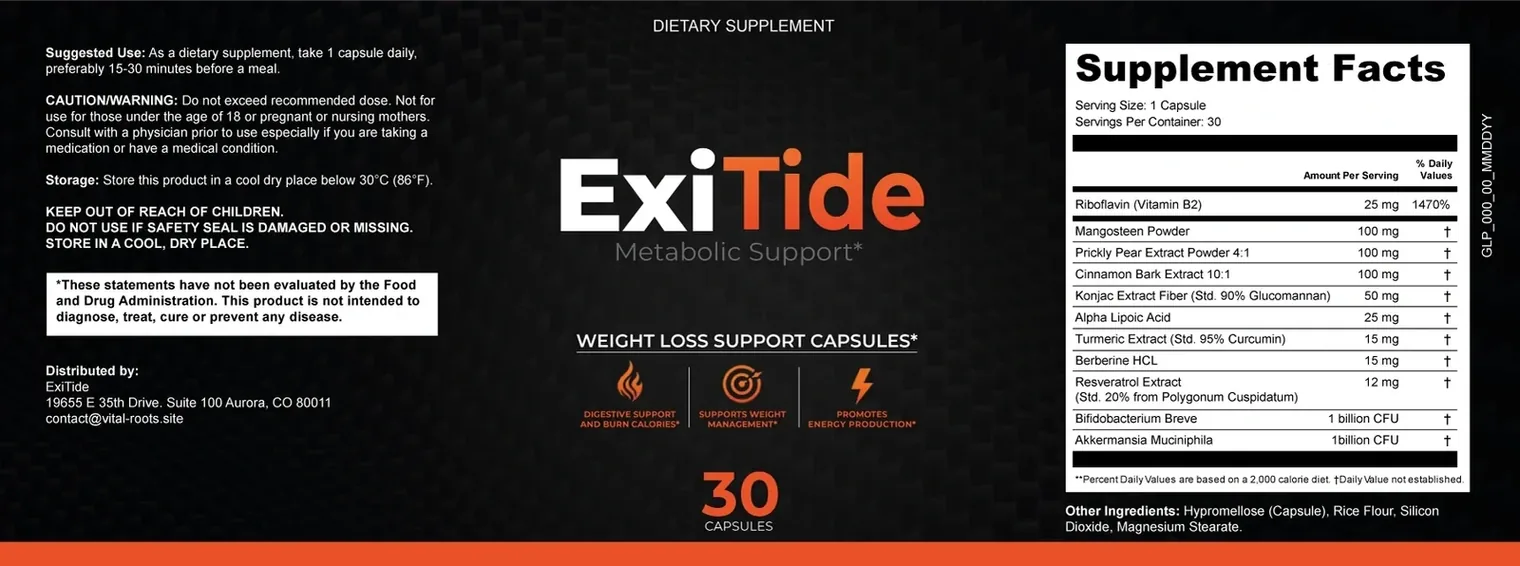
The ExiTide panel prints all eleven ingredient amounts, with no blend total hiding the parts. One capsule is one serving. Nine of the eleven sit below the amounts the research used, and three rows convert from a percentage, such as 90% of 50 mg giving 45 mg of glucomannan. Cinnamon at 100 mg is the one row inside range.
- Eleven names, eleven amounts. No blend total standing in for the parts, and one capsule is one serving.
- Three rows convert. 90% of 50 mg is 45 mg of glucomannan, 95% of 15 mg is about 14 mg of curcuminoids, 20% of 12 mg is 2.4 mg of resveratrol.
- One row has no gap. Cinnamon bark extract at 100 mg falls inside the range its trials used.
- One finding costs this product something. The only trial here that measured metabolic rate directly found resveratrol lowered it.
A panel that prints all eleven
Most panels in this category print a proprietary blend, where several names share one combined weight, or print a short list on the artwork and leave the rest to the back. This one does neither. Eleven names, eleven amounts, one capsule a serving.
An amount you cannot see is an amount you cannot check. A printed one can be set beside the published research on that ingredient, and nine of the eleven come out below the amounts that research used. Saying so is the price of a panel worth reading.
The seller's listing artwork names six. The printed label adds turmeric extract, berberine, resveratrol extract and the two live cultures. The ingredients page takes the eleven one at a time, and the panel page transcribes the whole thing.
The arithmetic a standardisation lets you do
Three rows carry a standardised percentage, which is the one piece of label wording a reader can convert unaided.
A standardisation names the compound
Konjac Extract Fiber (Std. 90% Glucomannan) is printed at 50 mg. Ninety per cent of fifty is forty-five, so the capsule carries about 45 mg of glucomannan. Turmeric Extract (Std. 95% Curcumin) at 15 mg comes to about 14 mg of curcuminoids, and Resveratrol Extract (Std. 20%) at 12 mg comes to 2.4 mg of resveratrol. One multiplication every time — printed milligrams times printed percentage.
A ratio names the concentration, not the compound
Prickly Pear Extract Powder 4:1 and Cinnamon Bark Extract 10:1 make a weaker statement. Four parts of raw material were concentrated into one part of powder, which is how much plant went in rather than how much of any compound came out. So 100 mg of a 10:1 cinnamon extract stands behind roughly a gram of bark — a plant equivalent rather than an equals sign.
| How the row is written | What it states | What converts |
|---|---|---|
| A name and a weight, as in mangosteen powder 100 mg | The weight of the material itself | Nothing. The figure is the material. |
| A ratio, as in prickly pear 4:1 | How much plant made one part of powder | A plant equivalent, and no compound. |
| A standardisation, as in konjac 90% | The compound as a share of the printed weight | The compound itself, by one multiplication. |
| A colony-forming unit count, as in both live cultures | How many organisms are counted alive | Nothing into milligrams. |
Eleven rows against eleven research amounts
None of the papers behind the right-hand column studied this capsule. They studied single ingredients, usually alone. So the comparison runs one way only: it says whether a trial result can be carried across to this amount, and where it cannot, it says nothing else.
| Row, in the panel's own order | One capsule gives | Against the research |
|---|---|---|
| Riboflavin (Vitamin B2) 25 mg | 25 mg | 1.3 mg a day for adult men. About nineteen times over. |
| Mangosteen powder 100 mg | 100 mg of fruit powder | 400 mg a day of a 40% mangostin extract. A quarter of the mass. |
| Prickly pear extract 4:1, 100 mg | about 400 mg of plant equivalent | 200 mg a day for sixteen weeks, which changed nothing between groups. |
| Cinnamon bark extract 10:1, 100 mg | about 1 g of bark equivalent | 120 mg to 6 g a day. Inside the range, and alone in that. |
| Konjac extract fibre (90% glucomannan) 50 mg | 45 mg of glucomannan | 1.24 to 3.99 g a day. About a twenty-eighth of the smallest. |
| Alpha lipoic acid 25 mg | 25 mg | 300 mg to 1,800 mg a day. About a twelfth. |
| Turmeric extract (95% curcumin) 15 mg | about 14 mg of curcuminoids | 80 mg to 1,890 mg a day. About a sixth of the lowest. |
| Berberine HCL 15 mg | 15 mg | Above 1 g a day for eight weeks. About a sixty-seventh. |
| Resveratrol extract (20%) 12 mg | 2.4 mg of resveratrol | 150 mg a day for thirty days. About a sixty-third. |
| Bifidobacterium breve 1 billion CFU | 1 billion CFU, no strain | 20 billion CFU a day of strain B-3. A twentieth. |
| Akkermansia muciniphila 1 billion CFU | 1 billion CFU | 10 billion a day, significant results in the pasteurised arm. |
The first two columns are the panel and arithmetic on it. The third is what each source below states its studies used.
Read down the middle column and the shape of the formula appears. The three 100 mg rows and the riboflavin row are the substantial ones — the four smallest by weight are where the distance is largest.
The one row inside the studied range
Cinnamon Bark Extract 10:1 at 100 mg stands behind about a gram of bark, and Allen 2013, pooling ten randomised trials in 543 people with type 2 diabetes, reports the studied range as 120 mg a day to 6 g a day. This amount sits inside it, and it is the only row on the panel of which that is true.
Those trials found fasting plasma glucose down by 24.59 mg/dL, with reductions in total cholesterol, LDL and triglycerides and a small rise in HDL. They did not find a change in HbA1c, the measure that reflects months rather than a morning: minus 0.16%, on an interval from minus 0.39 to 0.02, which crosses zero. Heterogeneity ran as high as 94.72%, and the authors write that this may limit how far the results can be applied, because the preferred dose and duration are unclear.
NCCIH separates Ceylon cinnamon from cassia and says the types and parts have important differences in chemical composition, coumarin among them. The panel prints a ratio and a weight, and names no species.
A capsule whose amounts you can check
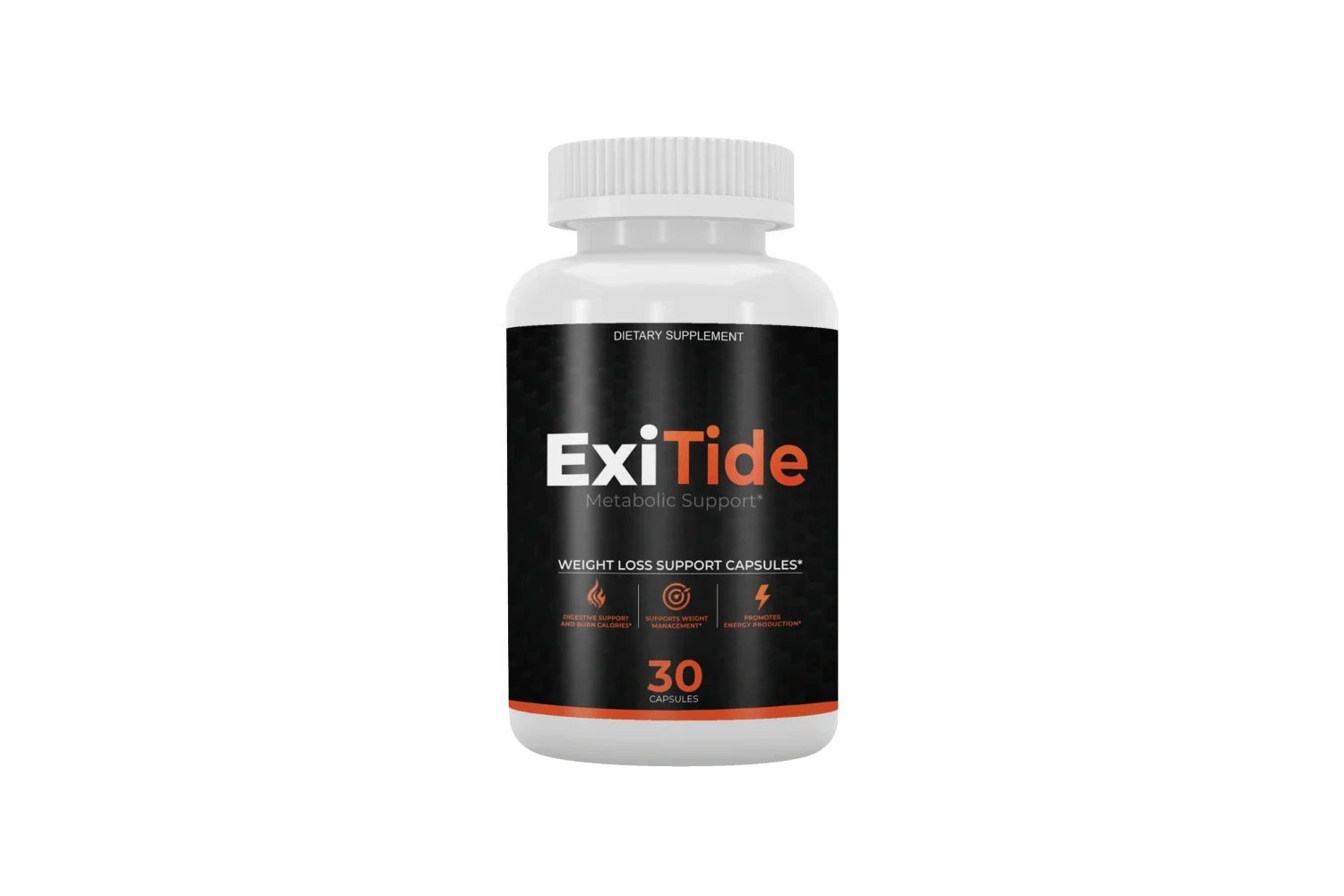
Eleven named ingredients with every amount printed, one capsule a day, and sixty days from purchase to change your mind.
$49 to $79 a bottle · 60-day money-back guarantee
Order ExiTideThe finding that costs this product something
Resveratrol Extract at 12 mg and 20% is 2.4 mg of resveratrol, and it is the row this desk would leave out if it were selling rather than describing.
The trial people reach for is Timmers 2011: eleven obese men, thirty days, a double-blind crossover, 150 mg a day. It found most of what the mechanism stories describe, including AMPK activation, higher SIRT1 and PGC-1α, better mitochondrial respiration in muscle, lower circulating glucose and triglycerides and an improved HOMA index. It also found something rarely repeated when the paper is cited on a sales page. Resveratrol significantly reduced sleeping and resting metabolic rate. Both went down, and the authors' own framing for the whole result is that it mimics calorie restriction.
At 2.4 mg, about a sixty-third of that dose, nothing from the trial transfers in either direction. This capsule will not slow anything and it will not speed anything. What the finding settles is a question of language — the one paper cited here that measured metabolic rate directly measured it falling, so no page on this website calls resveratrol a metabolism booster.
The wider picture matches. An umbrella review of 38 meta-analyses, Zeraattalab-Motlagh 2021, concludes that current evidence does not support resveratrol for managing cardiometabolic risk factors in type 2 diabetes, metabolic syndrome or fatty liver disease. The authors flag one exception and it is fair to quote that too: short-term HbA1c under twelve weeks showed a clinically important effect at moderate certainty, in six small trials.
What a dose gap does and does not mean
A gap between a printed amount and a trial amount is a statement about evidence rather than a verdict on an ingredient.
- The trial cannot be carried across. NCCIH puts the berberine weight findings above 1 gram a day, and 15 mg is a sixty-seventh of that.
- It does not mean nothing happens. Most of these amounts have never been tested alone, so the position is an absence of evidence either way.
- It is neither a safety margin nor a safety warning. Tolerability is answered on the side-effects page.
- It does not carry across a combination. No trial of this finished formula has been published.
- It exists only because the amounts are printed. On a proprietary blend the comparison cannot be attempted, which is not the same as passing it.
The two rows measured in organisms, not milligrams
Bifidobacterium Breve and Akkermansia Muciniphila are each printed at 1 billion CFU. Colony-forming units count organisms that are alive rather than weighing material, and do not convert into milligrams at all. The definition the field uses, from the ISAPP expert consensus, is live microorganisms which when administered in adequate amounts confer a health benefit on the host. Adequate is set per strain, and both rows here name a species and no strain. The article on the two live cultures takes both apart properly.
Doing this on any panel in ten minutes
Nothing above needed a subscription or a laboratory. It is a sequence anyone can run on any panel.
- Find the serving size first. Every amount is per serving, and a serving is not always one capsule. Here it is.
- Count the names against the amounts. Where several share one weight, each amount is a ceiling rather than a figure.
- Convert every standardisation. Printed weight times printed percentage, then search on the answer.
- Read a ratio as a plant equivalent. A 10:1 extract at 100 mg is about a gram of starting material and no statement about a compound.
- Look up one dose, not eleven. Take the ingredient the marketing leans on hardest and find the range a review reports.
- Write down what the panel does not say. Here — the cinnamon species, the two strain codes, the fill weight.
What this desk will not say about the panel
This website earns money when an order goes through it, so the list below is the part worth reading.
- That any ingredient here changes what the scales say. The two fibre meta-analyses cited across this site are null on body weight.
- That the capsule raises metabolic rate. The one trial here that measured it measured it falling.
- That berberine at 15 mg does what berberine did in the diabetes trials.
- That the cultures in this bottle are the cultures that were trialled. The panel names species; the trials named strains.
- That a facility registration means the product was checked. The FDA's own page calls registration a listing rather than an approval, in those words.
- That anything here is clinically proven. This desk would print the trial if one existed.
The positive version is shorter. Eleven amounts, two extract ratios and two standardised percentages are printed, one row sits inside the range its trials used, and the guarantee runs sixty days.
Sources cited in this article
- Allen RW, Schwartzman E, Baker WL, Coleman CI, Phung OJ. Cinnamon use in type 2 diabetes: an updated systematic review and meta-analysis. Ann Fam Med. 2013;11(5):452-9. https://pubmed.ncbi.nlm.nih.gov/24019277/
- National Center for Complementary and Integrative Health. Cinnamon: Usefulness and Safety. https://www.nccih.nih.gov/health/cinnamon
- Timmers S, Konings E, Bilet L, et al. Calorie restriction-like effects of 30 days of resveratrol supplementation on energy metabolism and metabolic profile in obese humans. Cell Metab. 2011;14(5):612-22. https://pubmed.ncbi.nlm.nih.gov/22055504/
- Zeraattalab-Motlagh S, Jayedi A, Shab-Bidar S. The effects of resveratrol supplementation in patients with type 2 diabetes, metabolic syndrome, and nonalcoholic fatty liver disease: an umbrella review of meta-analyses of randomized controlled trials. Am J Clin Nutr. 2021;114(5):1675-1685. https://pubmed.ncbi.nlm.nih.gov/34320173/
- National Center for Complementary and Integrative Health. Berberine and Weight Loss: What You Need To Know. https://www.nccih.nih.gov/health/berberine-and-weight-loss-what-you-need-to-know
- Hill C, Guarner F, Reid G, et al. Expert consensus document. The International Scientific Association for Probiotics and Prebiotics consensus statement on the scope and appropriate use of the term probiotic. Nat Rev Gastroenterol Hepatol. 2014;11(8):506-14. https://pubmed.ncbi.nlm.nih.gov/24912386/