ExiTide Official Website › Blog › Riboflavin at 1,470%
ExiTide Riboflavin Explained: What 1,470% of the Daily Value Means
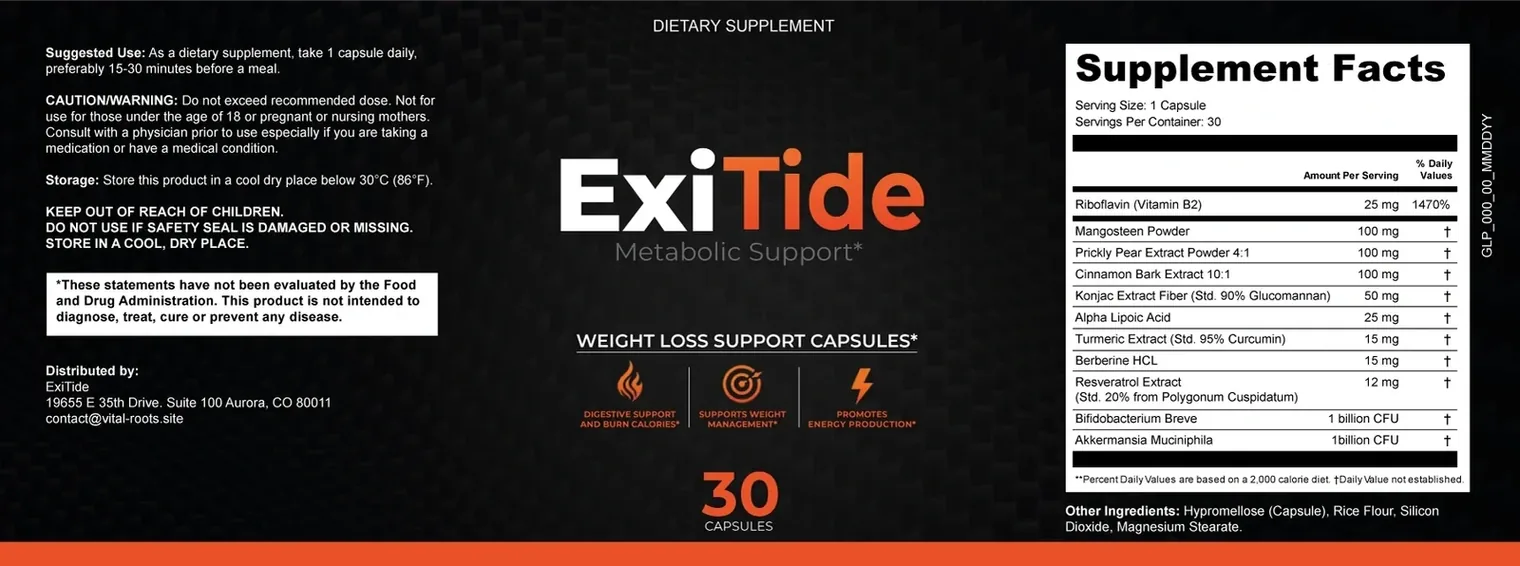
ExiTide lists riboflavin at 1,470% of the Daily Value, the only percentage on its panel, while ten rows carry a dagger instead. The 25 mg is a water-soluble vitamin, and the bright yellow urine buyers report is explained once on this page. The panel prints all eleven amounts, so each can be read against its own row.
- One row in eleven carries a percentage. Riboflavin at 25 mg and 1,470% of the Daily Value. The other ten carry a dagger.
- A dagger is not a warning. It marks a row for which no Daily Value has been established, which is a fact about the labelling reference rather than the ingredient.
- The other comparison. The adult recommended intake is 1.3 mg a day for men, so 25 mg is about nineteen times that figure.
- Why a large number here is not alarming. Riboflavin is water-soluble, no upper intake limit has been set, and what is absorbed in excess leaves in the urine.
One percentage and ten daggers
Look down the right-hand column of this panel and the pattern is immediate. Riboflavin carries 1,470%. The other ten rows carry a dagger, and the foot of the panel explains it: percent Daily Values are based on a 2,000 calorie diet, and a dagger marks a row for which no Daily Value has been established.
That is not a hierarchy of quality. Daily Values exist for nutrients with an established reference intake, which means vitamins, minerals and a handful of others. There is no Daily Value for mangosteen powder, a konjac extract or a live culture, because no authority has set a recommended daily intake for any of them. A dagger says the reference does not exist. It says nothing about the ingredient.
So one row here can be expressed as a percentage and ten cannot. The panel page transcribes all eleven rows in the label's own order.
What a percent Daily Value is measuring
A percent Daily Value compares the amount in one serving against a single reference figure used on labels. It is a labelling device, built so two products can be compared on the same scale, and it is not a recommendation aimed at any particular reader.
Recommended intakes are a separate thing, set by age and sex. The NIH fact sheet on riboflavin puts the adult recommended dietary allowance at 1.3 mg a day for men and 1.1 mg for women aged 19 to 50. Divide 25 mg by 1.3 mg and the answer is about nineteen times — a different figure from the panel's percentage because it answers a different question.
Both are honest and neither is the whole story. The percentage is the label's own. The multiple of the recommended intake is the comparison a reader is usually trying to make, and it is worth doing rather than assuming.
| Comparison | The figure | What it means here |
|---|---|---|
| The panel's own percentage | 1,470% of the Daily Value | The label's arithmetic against the Daily Value used on labels, and the only percentage on this panel. |
| The recommended intake for adults | 1.3 mg a day for men, 1.1 mg for women aged 19 to 50 | 25 mg is about nineteen times the male figure. A different question from the one above. |
| Where absorption falls away | Little is absorbed from single doses beyond about 27 mg | 25 mg sits just under that, so most of one capsule is inside the range the body takes up at once. |
The second and third rows are from the NIH fact sheet on riboflavin. The first is printed on the bottle.
What each column of a panel row can tell you
Once the percentage column makes sense, the rest of a row is easier to read. Four columns, four kinds of statement — each with a clear boundary.
| Column | What it states | What it does not state |
|---|---|---|
| Ingredient name | Which substance, and often its form or extract ratio | Which species, which part of the plant, or which strain. |
| Amount per serving | The weight or count in one serving, as declared | How much is absorbed, or how much reaches anywhere. |
| % Daily Value | The amount as a share of one labelling reference figure | What any individual needs. Intakes are recommended by age and sex. |
| A dagger in place of a percentage | That no Daily Value has been established for that substance | Anything about safety, quality or a sensible amount. |
Serving size is printed above the table and should be read first: every figure in the rows is per serving, and a serving is not always one capsule. Here it is.
Applied to this bottle the four columns say: eleven named substances, an amount beside every one, one percentage and ten daggers, at a serving size of one capsule with thirty servings a container. The ingredients page takes each name in turn.
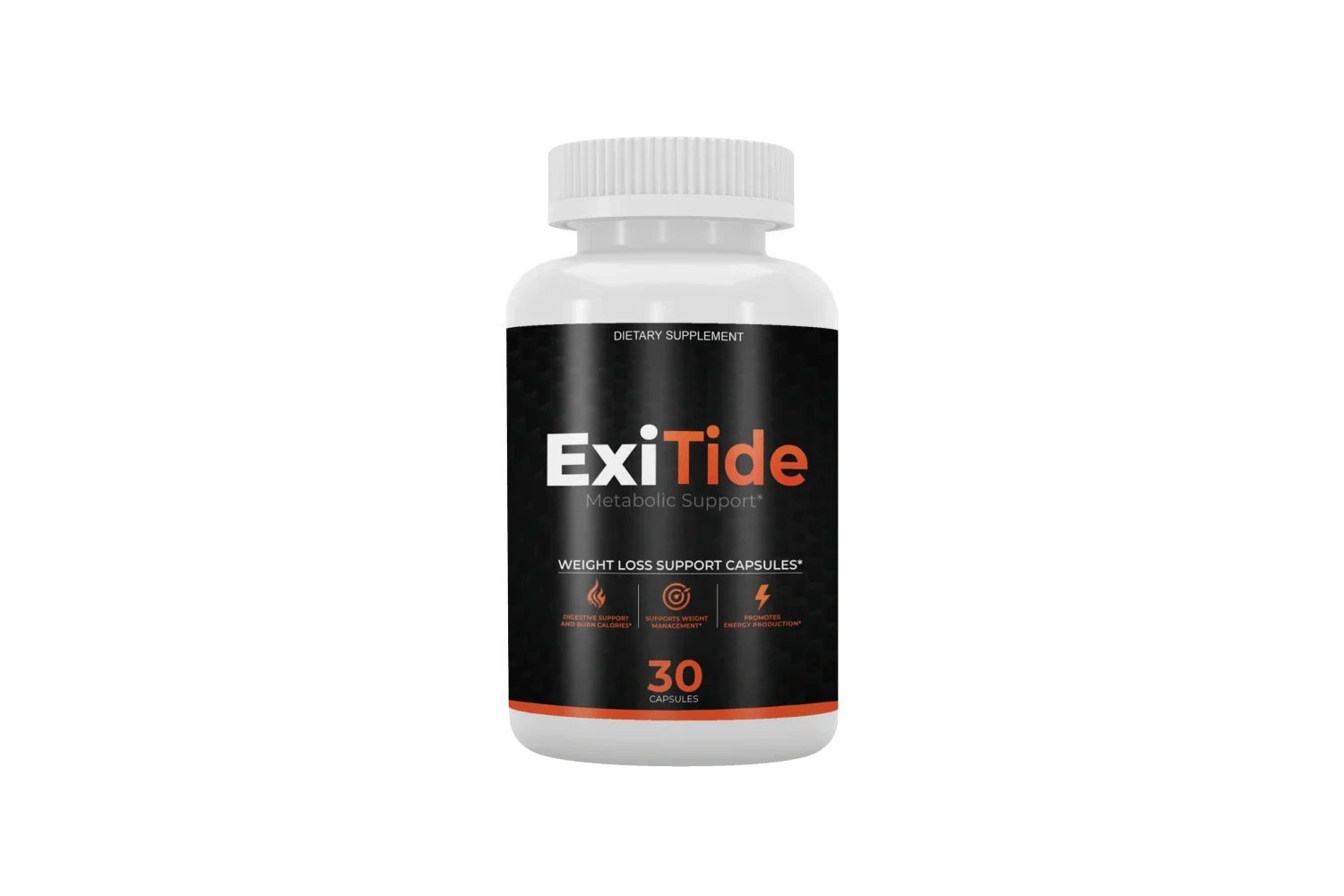
A panel that prints all eleven amounts
One capsule a day, thirty to a bottle, with every amount on the label rather than folded into a blend, and sixty days from purchase to change your mind.
$49 to $79 a bottle · 60-day money-back guarantee
Order ExiTideWater-soluble, and what that changes
MedlinePlus describes the basic property in language worth borrowing: riboflavin is water soluble, which means it is not stored in the body. Leftover amounts leave through the urine, the body keeps a small reserve, and these vitamins have to be taken regularly to maintain it.
What it does is less mysterious than the percentage makes it look. The same page says riboflavin works with the other B vitamins, is important for growth and red blood cell production, and aids in the release of energy from carbohydrates, proteins and fats. The NIH fact sheet puts it in biochemical terms: riboflavin is the precursor of the coenzymes FMN and FAD, which play major roles in energy production, in cellular function, growth and development, and in the metabolism of fats, drugs and steroids.
That last clause is why a metabolic support formula carries a B vitamin at all — and it is also the sentence most easily overstretched. Being a coenzyme in energy production describes what riboflavin is for. It is not a claim that more of it produces more energy in somebody who already has enough.
The bright yellow urine, explained once
This is the one same-day effect worth naming, and naming it once is enough. A dose of riboflavin well above the recommended intake will usually turn the urine a vivid yellow within a day. The NIH fact sheet records that the body absorbs little from single doses beyond roughly 27 mg and that what is absorbed in excess leaves in the urine, which is exactly what produces the colour.
It is expected, it is harmless — and it is not evidence that anything is working. It is evidence that a water-soluble vitamin passed through, which would happen with a riboflavin tablet from any pharmacy shelf. The side-effects page lists it alongside the rest of the panel.
Why no upper limit has been set
A large percentage beside a vitamin raises a reasonable question about too much, and for this one the answer is on the record. The Food and Nutrition Board has set no Tolerable Upper Intake Level for riboflavin, because adverse effects have not been reported even at 400 mg a day for three months. MedlinePlus puts the same point in one line: there is no known poisoning from riboflavin.
A second piece of reassurance is easy to miss. The NIH fact sheet states that riboflavin is not known to have any clinically relevant interactions with medications. On a panel where berberine carries a documented interaction at 900 mg a day, that is a genuine difference between two rows.
None of it generalises. No upper limit for riboflavin is a statement about riboflavin rather than a rule about every vitamin with a three-figure percentage beside it, and a fat-soluble nutrient behaves differently because the body can store it.
What 25 mg does not buy
The honest limit on this row is that neither source above makes any case for taking more than the recommended intake. They describe what riboflavin does in the body and what happens when someone is short of it. They do not say extra does extra in someone who is not. So the sentences that follow from 1,470% are narrower than the number suggests:
- It is a nutrient fact, not an efficacy finding. The NIH page is a fact sheet rather than a trial report.
- It says nothing about body weight, metabolic rate or fat, and this website makes no such claim.
- It is not a reason on its own to pick one product over another. Riboflavin is inexpensive and a large percentage of it is not hard for any maker to print.
- It does not make the other ten rows more credible. Each has its own evidence and its own gaps, which the article on the eleven printed amounts goes through one at a time.
The fair thing to say is that this row is generous, cheap, well tolerated and openly printed. That is four true things, and it is the whole of what a percentage in the right-hand column can earn.
Reading a percentage on any panel
The habits below take under a minute each and work on any supplement in any shop.
- Read the serving size first. Every percentage is per serving, so a large figure at three capsules a serving is a smaller statement than it looks.
- Ask what it is measured against. A percent Daily Value is a labelling reference; the intake recommended for your age and sex is a separate published figure.
- Treat a dagger as neutral. A panel full of daggers is a panel full of botanicals — which is ordinary.
- Check whether the nutrient is water-soluble. Where the body stores a nutrient, a large percentage is a more interesting number.
- Look for the upper intake limit rather than the percentage. Where one has been set it is the number that matters.
- Read the daggered rows for what they do print. Here they print amounts, two extract ratios and two standardised percentages.
What this desk will not say about the riboflavin row
- That 1,470% makes this a high-potency product. It makes one row of eleven a generous one.
- That riboflavin raises metabolic rate or changes body composition. The sources cited here describe a coenzyme's role and set recommended intakes.
- That a big percentage is evidence of quality. It is evidence of an inexpensive nutrient included generously.
- That the dagger rows are hiding something. All ten print their amounts anyway.
- That anyone needs 25 mg. The recommended intake is a fraction of it.
The row is worth understanding because the number is the first thing a reader sees and the last thing most pages explain. Twenty-five milligrams of a water-soluble B vitamin, printed with its percentage, on a panel that prints every other amount too. The how-it-works page sets the row in the context of the other ten.
Sources cited in this article
- NIH Office of Dietary Supplements. Riboflavin: Fact Sheet for Health Professionals. https://ods.od.nih.gov/factsheets/Riboflavin-HealthProfessional/
- MedlinePlus, U.S. National Library of Medicine. Riboflavin. https://medlineplus.gov/ency/article/002411.htm
- Guo Y, Chen Y, Tan ZR, Klaassen CD, Zhou HH. Repeated administration of berberine inhibits cytochromes P450 in humans. Eur J Clin Pharmacol. 2012;68(2):213-7. https://pubmed.ncbi.nlm.nih.gov/21870106/
- U.S. Food and Drug Administration. Structure/Function Claims. https://www.fda.gov/food/nutrition-food-labeling-and-critical-foods/structurefunction-claims