ExiTide Official Website › Blog › ExiTide ingredients list
What Is in ExiTide? The Full Ingredient List, Row by Row
Each ExiTide capsule lists eleven ingredients with an amount beside every one: riboflavin 25 mg, mangosteen, prickly pear and cinnamon bark at 100 mg each, konjac fibre 50 mg, alpha lipoic acid 25 mg, turmeric 15 mg, berberine 15 mg, resveratrol 12 mg and two cultures at 1 billion CFU. Four other ingredients make up the shell and fillers.
- Serving size is 1 capsule, with 30 servings per container.
- No proprietary blend: all eleven amounts are printed.
- Three rows carry a standardisation and two carry an extract ratio, so named compounds can be worked out.
- Other ingredients: hypromellose (capsule), rice flour, silicon dioxide, magnesium stearate.
- Not printed: the cinnamon species, the culture strains, a certifying body for the seals, or a laboratory report.
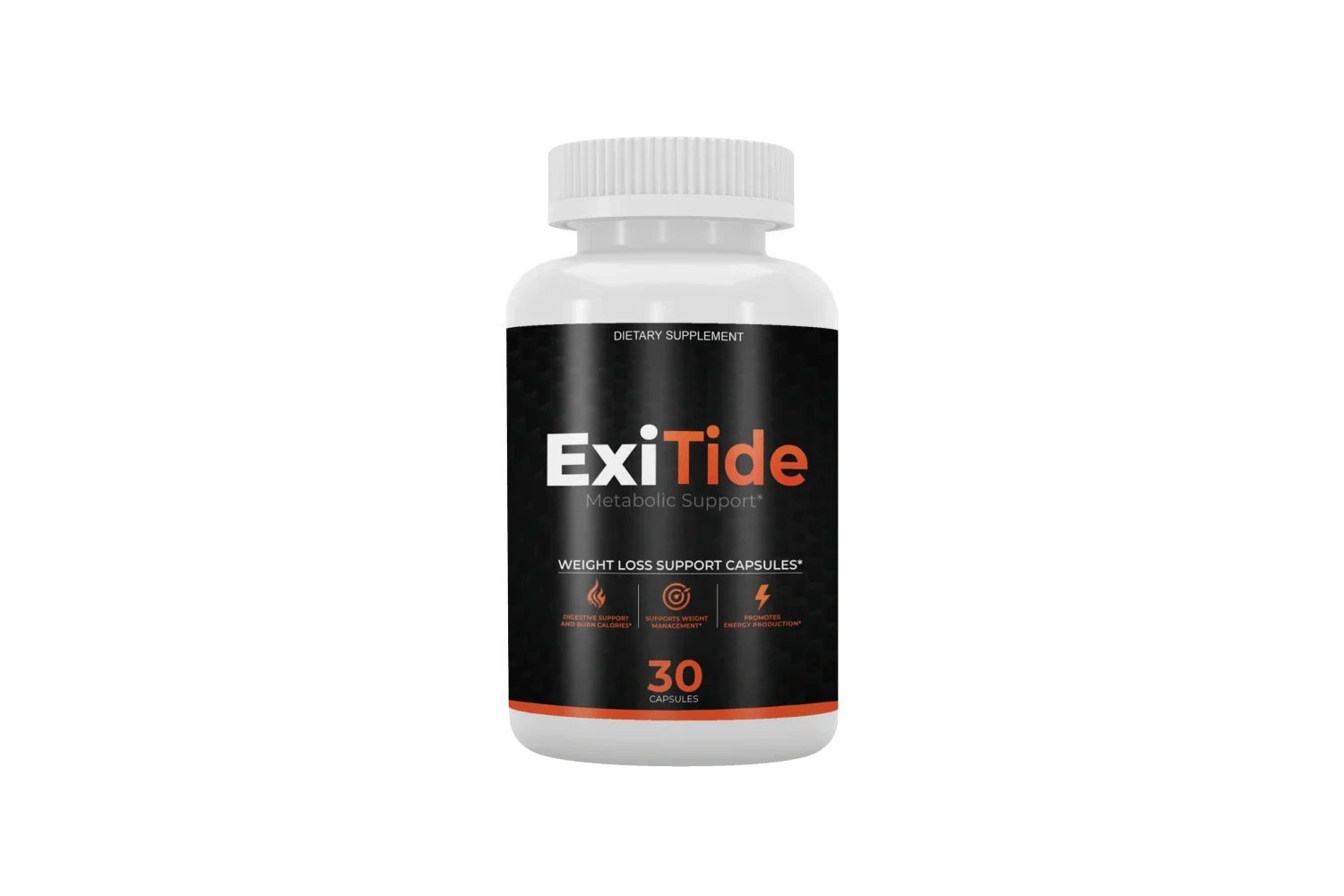
Want the panel and the price on one page?
The official order page shows the pack options and the 60-day terms, and this article lets you check the label against them.
$49 to $79 a bottle · 60-day money-back guarantee
See today’s price and guaranteeGetexitide earns money on orders placed through this website. The checkout shows the live price before any payment details are asked for.
How do you read a Supplement Facts panel?
Start at the top. The serving size is one capsule, and the container holds 30 servings. Everything below is the amount in that one capsule, not in a day's worth of anything else. The percent Daily Value column is based on a 2,000 calorie diet. A dagger marks a row for which no Daily Value has been established, which is why only riboflavin carries a percentage.
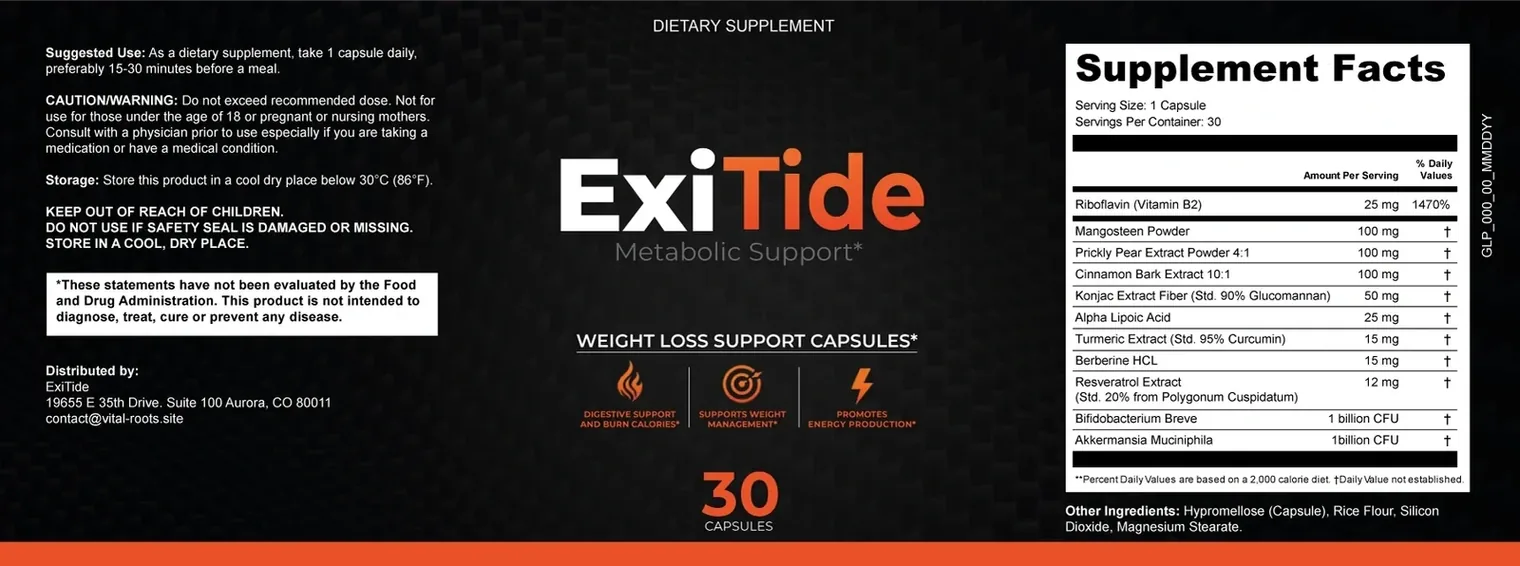
Reading a panel well means checking three things: is every amount printed, is the unit sensible, and is anything grouped into a total? Here every row has its own amount, and nothing is hidden inside a blend total.
What does the panel print for each ingredient?
| Fact | What is published |
|---|---|
| Riboflavin (Vitamin B2) | 25 mg (1470% Daily Value) |
| Mangosteen Powder | 100 mg |
| Prickly Pear Extract Powder 4:1 | 100 mg |
| Cinnamon Bark Extract 10:1 | 100 mg |
| Konjac Extract Fiber (Std. 90% Glucomannan) | 50 mg, about 45 mg glucomannan |
| Alpha Lipoic Acid | 25 mg |
| Turmeric Extract (Std. 95% Curcumin) | 15 mg, about 14 mg curcuminoids |
| Berberine HCL | 15 mg |
| Resveratrol Extract (Std. 20% from Polygonum Cuspidatum) | 12 mg, about 2.4 mg resveratrol |
| Bifidobacterium Breve | 1 billion CFU |
| Akkermansia Muciniphila | 1 billion CFU |
| Other ingredients | Hypromellose (capsule), rice flour, silicon dioxide, magnesium stearate |
What do 4:1, 10:1 and “Std. 90%” mean?
A ratio such as 4:1 or 10:1 describes concentration. A 10:1 extract means ten parts of raw material were reduced to one part of extract. So 100 mg of cinnamon bark extract 10:1 stands for roughly a gram of bark, though the chemistry of an extract is not the same as the chemistry of bark powder. The prickly pear extract is 4:1 in the same way.
A standardisation, written as Std. with a percentage, names the share of a marker compound. Konjac extract fibre at 50 mg and 90% glucomannan gives about 45 mg of glucomannan. Turmeric extract at 15 mg and 95% curcumin gives about 14 mg of curcuminoids. Resveratrol extract at 12 mg and 20% gives about 2.4 mg of resveratrol.
That arithmetic is the useful part. It turns a name into a number you can compare with a study. It also shows how small some of the numbers are.
What are the other four ingredients for?
The other ingredients line lists hypromellose for the capsule, rice flour, silicon dioxide and magnesium stearate. Hypromellose is a plant cellulose, so the shell is not gelatin. That is what the vegetarian seal on the artwork rests on.
Count the names and you get fifteen in total: eleven on the panel and four in the other line. None of the fifteen is a wheat, barley, rye or dairy ingredient, which lets the gluten-free and dairy-free seals be read against a real list. The label prints no allergen statement and no test result, so a reader with a serious allergy should still ask the seller or a doctor.
How do the amounts compare with research doses?
Berberine HCL at 15 mg, turmeric extract at 15 mg and resveratrol extract at 12 mg are all well below the amounts used in research on those single ingredients, which generally ran to hundreds of milligrams a day. The panel is honest about what it contains. It is a low dose of those three.
The fibre tells a similar story. Pooled glucomannan trials used 1.24 to 3.99 g a day; this capsule has about 45 mg. Riboflavin goes the other way: 25 mg is about nineteen times the adult recommended intake of 1.3 mg a day for men, though no upper limit has been set.
None of this makes the formula good or bad. It means a study on one ingredient at a high dose cannot be borrowed to describe this capsule. Our article on the eleven amounts against the research sets the numbers side by side.
What is not printed on the label?
Several details a careful buyer might want are not published. The cinnamon species is not named, and the label gives no coumarin content. The two cultures are named to species, not to strain, so no strain study applies. A certifying body and audit date for the Good Manufacturing Practice seal are not published.
The lot EXI-26/GE-7602 and the certificate reference EXI-7602-26-GE are label markings. They are not a published laboratory report, and a lot code is not a purity test or a potency test. The lot and best-before are stamped on the base of the bottle.
FDA statement, as printed on the label. These statements have not been evaluated by the Food and Drug Administration. This product is not intended to diagnose, treat, cure or prevent any disease.
What should you do with this list before you buy?
Take the printed panel to a doctor or pharmacist if you use any prescription. The one entry that deserves a specific question is berberine, which is known to affect how some medicines are cleared from the body. The safety guide has the details.
Then compare the panel with anything else you already take. A multivitamin may contain riboflavin too, and a separate probiotic may duplicate the two species. Overlap is not necessarily harmful, but you should know about it.
Frequently asked questions
What are the ingredients in ExiTide?
Riboflavin, mangosteen powder, prickly pear extract, cinnamon bark extract, konjac extract fibre, alpha lipoic acid, turmeric extract, berberine HCL, resveratrol extract, Bifidobacterium breve and Akkermansia muciniphila, plus hypromellose, rice flour, silicon dioxide and magnesium stearate.
How many ingredients does ExiTide have?
Eleven on the Supplement Facts panel, each with an amount. Four more appear in the other ingredients line, making fifteen named components.
Is there a proprietary blend in ExiTide?
No. Every one of the eleven rows prints its own amount and no grouped total appears.
What is the serving size on the ExiTide label?
One capsule, with 30 servings per container. The suggested use is one capsule daily, preferably 15-30 minutes before a meal.
Why does riboflavin show 1470% on the ExiTide label?
Because the Daily Value for riboflavin is small. 25 mg is far above it, and no tolerable upper intake level has been set for riboflavin.
Does the ExiTide label name the probiotic strains?
No. It names the species Bifidobacterium breve and Akkermansia muciniphila at 1 billion CFU each. No strain codes are printed.
Our view
The label is the strongest part of this product. Most panels in the category fall back on blends and totals; this one prints eleven numbers. That deserves credit.
Credit is not the same as endorsement. Three of those numbers are low compared with research, two live cultures lack strain names, and no laboratory report is published. Read the panel as an honest description of a modest formula, and judge it on those terms.
Read the label and still interested?
Today's price, the shipping line and the guarantee wording are on the official order page, shown before payment details are asked for.
$49 to $79 a bottle · 60-day money-back guarantee
See today’s price and guaranteeGetexitide earns money on orders placed through this website. The checkout shows the live price before any payment details are asked for.
Last updated
Sources named on this website and used here
- NIH Office of Dietary Supplements. Riboflavin: Fact Sheet for Health Professionals. https://ods.od.nih.gov/factsheets/Riboflavin-HealthProfessional/
- Onakpoya I, Posadzki P, Ernst E. The efficacy of glucomannan supplementation in overweight and obesity: a systematic review and meta-analysis of randomized clinical trials. J Am Coll Nutr. 2014;33(1):70-8. https://pubmed.ncbi.nlm.nih.gov/24533610/
- National Center for Complementary and Integrative Health. Cinnamon: Usefulness and Safety. https://www.nccih.nih.gov/health/cinnamon
- Hill C, Guarner F, Reid G, et al. Expert consensus document. The International Scientific Association for Probiotics and Prebiotics consensus statement on the scope and appropriate use of the term probiotic. Nat Rev Gastroenterol Hepatol. 2014;11(8):506-14. https://pubmed.ncbi.nlm.nih.gov/24912386/
- U.S. Food and Drug Administration. Structure/Function Claims. https://www.fda.gov/food/nutrition-food-labeling-and-critical-foods/structurefunction-claims